Stone Column Wraps
Real Stone Without the Weight
A stone column wrap is a facing installed around an existing post or column to give it the look of solid stone. Traditional options are cultured stone or natural veneer mortared onto lath, which add a lot of weight and labor. Thin natural stone panels, like the 8mm onyx, marble and quartzite Designer Stone Panels we distribute, wrap a column in real stone with far less weight, and translucent stones can be backlit so the column glows. Size, stone choice and lighting set the cost.
Columns look simple, but a wrap has four exposed faces, four corners, a top and a bottom, and every one of them shows. This page walks through what sits inside the column, how each wrapping method is built, how a column is lit from within, and what changes when the column stands outdoors.
First, Find Out What the Column Is
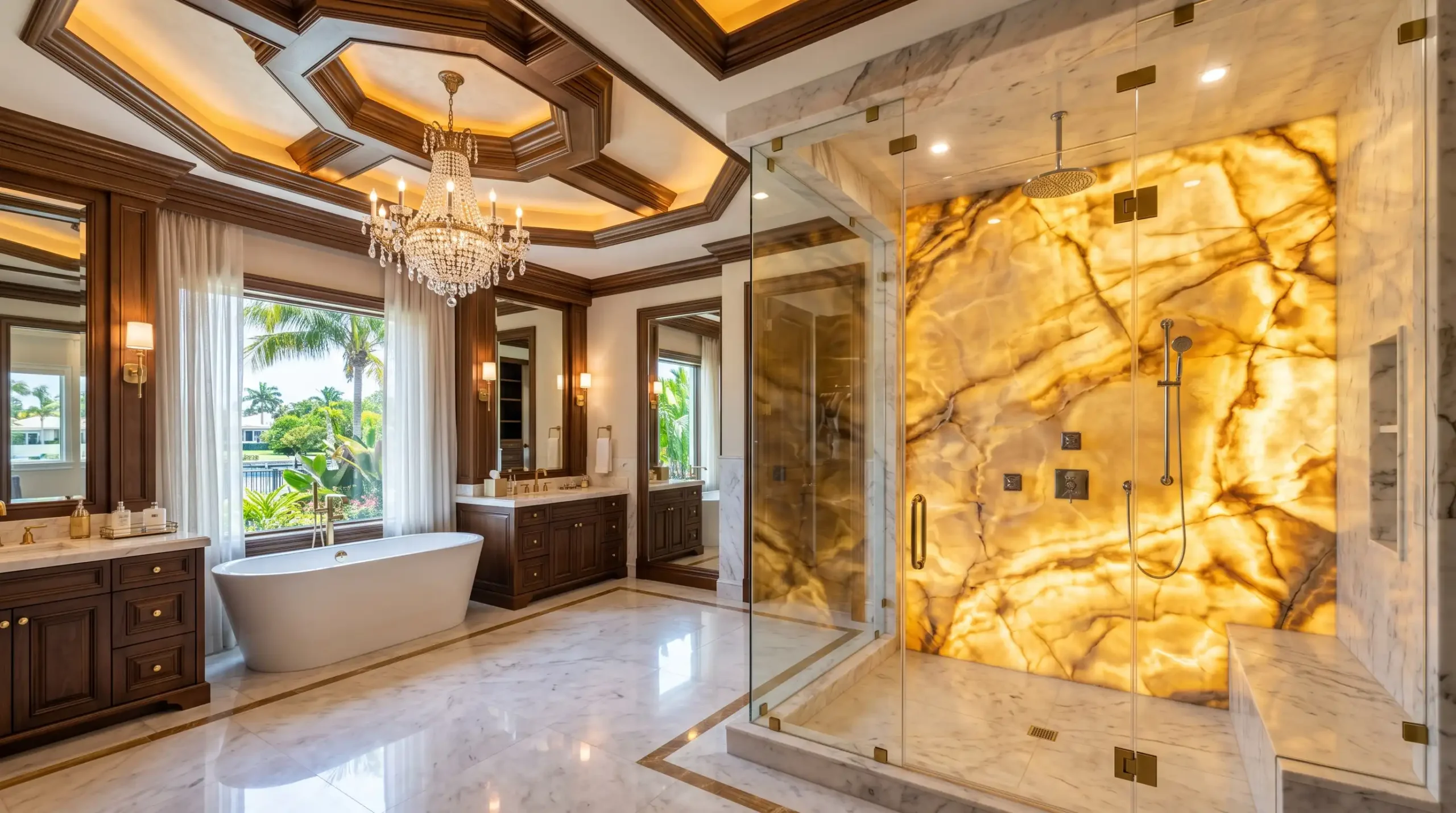
Every column wrap starts with the core. A wood post, steel column or block column is checked for soundness, then built out with a substrate to a square or rectangular profile at the finished size. For heavy veneer, that means lath and a mortar scratch coat with support at the base. Thin stone panels are cut to each face and bonded to the substrate, so the column grows only slightly and the existing structure carries little added load. Corners are mitered or finished with matching edges so the stone reads as solid.
Before any build-out, we confirm whether the column is carrying a beam or is purely decorative. Some interior columns hold up a girder or a header after a wall was removed; others are hollow covers around a plumbing chase or a duct. A load-bearing post is never notched or drilled to run wiring. Instead, the build-out leaves a cavity between the post and the stone, and cables travel in that space. If the column hides pipes or a drain line, we leave an access route so a future plumbing repair does not mean breaking stone.
Panel, Veneer or Synthetic Shell
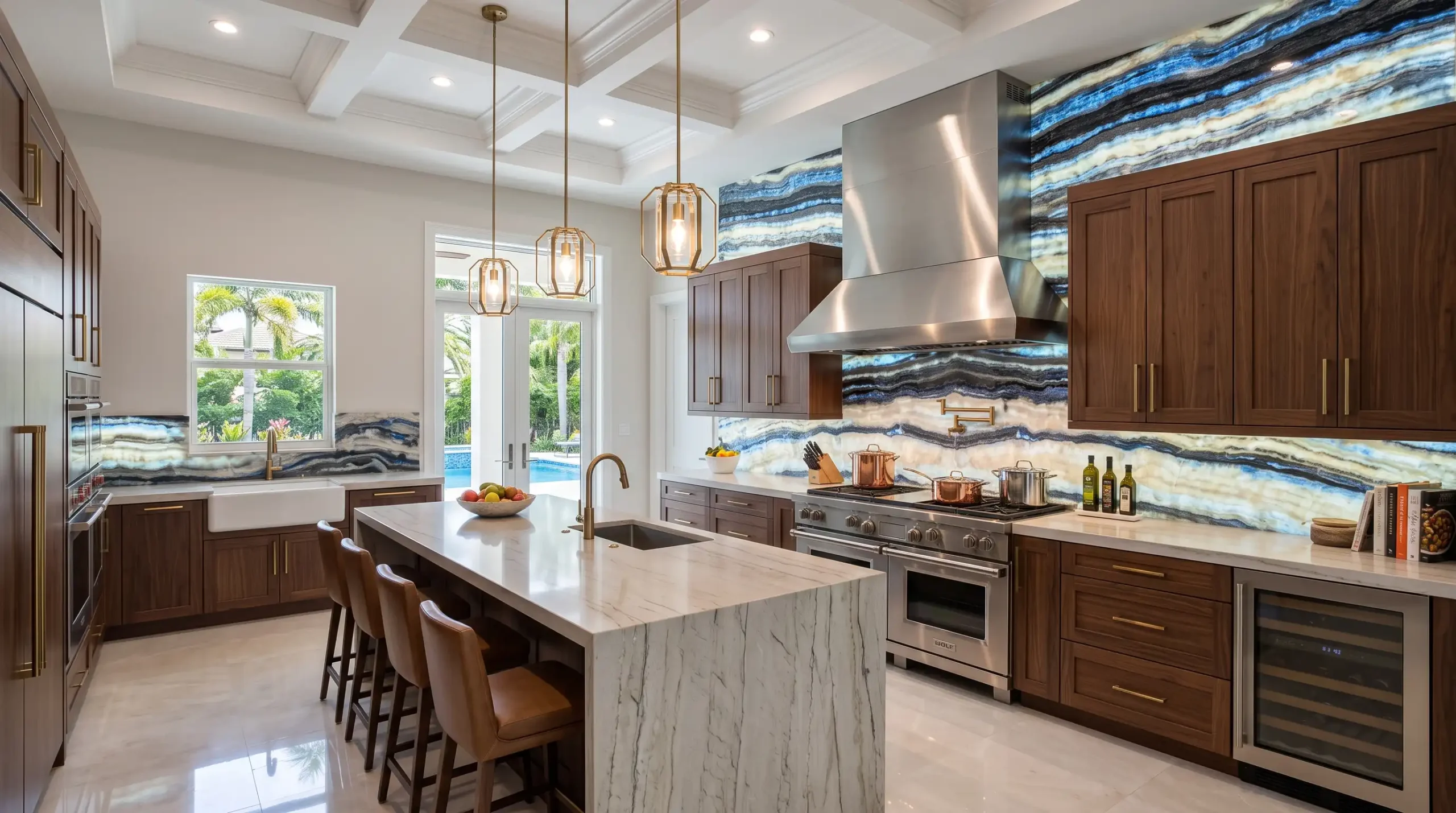
Backlighting changes the design. With translucent onyx or certain marbles, LED lighting goes behind the stone, and the build-out must leave room for it plus a path for the low-voltage wiring and driver. Square and rectangular columns are the simplest to wrap, while round columns are usually squared off with a new build-out or faceted. Cost depends on the stone, the column height and perimeter, whether it is backlit and how many columns are in the run, since a matching set in an entry or great room is more efficient than a single column.
| Thin stone panels | Stone veneer | Fiberglass or PVC wrap | |
|---|---|---|---|
| Material | Real onyx, marble or quartzite | Manufactured or natural stone pieces | Molded synthetic shell |
| Weight | Light | Heavy, needs support at the base | Very light |
| Install | Bonded to a built-out substrate | Lath, scratch coat and mortar | Fastened around the post |
| Backlighting | Possible with translucent stones | No | No |
| Look | Continuous natural stone faces | Rustic stacked texture | Painted or textured finish |
| Best use | Entry, great room and bar columns | Rustic exterior styles | Budget porch and lanai posts |
Corners decide whether a wrap looks like solid stone or like tile on a box. A mitered corner meets two panels at 45 degrees so the veining appears to turn the corner, which is the most convincing finish but leaves a thin edge. On columns at chair height or along a busy walkway we slightly ease that edge so a bump chips nothing, and we keep a stone or metal base at the floor where vacuums, mops and luggage wheels hit first.
Explore backlit onyx, marble and quartzite panels for columns, feature walls, bars and fireplace surrounds.
Lighting a Column From the Inside
A glowing column needs depth. The LEDs sit on the inside of the build-out, facing each stone panel, and the gap between light and stone is what turns a row of bright dots into a soft, even glow. That depth is added to the column’s finished size, so we design it with the room’s walkways and furniture in mind. Lighting all four faces from one central source rarely works; each face gets its own lighting so the column glows evenly from every side.
The power supply for the LEDs gives off some heat and will need service someday, so it does not get sealed inside the column. It typically goes in a nearby cabinet, a closet, the attic above with a permanent access point, or behind a removable stone cap. The column’s light should also run on its own switch or dimmer, separate from the room’s ceiling lights, so it can be the only light on during an evening.
What Works for Columns in a Florida Home?
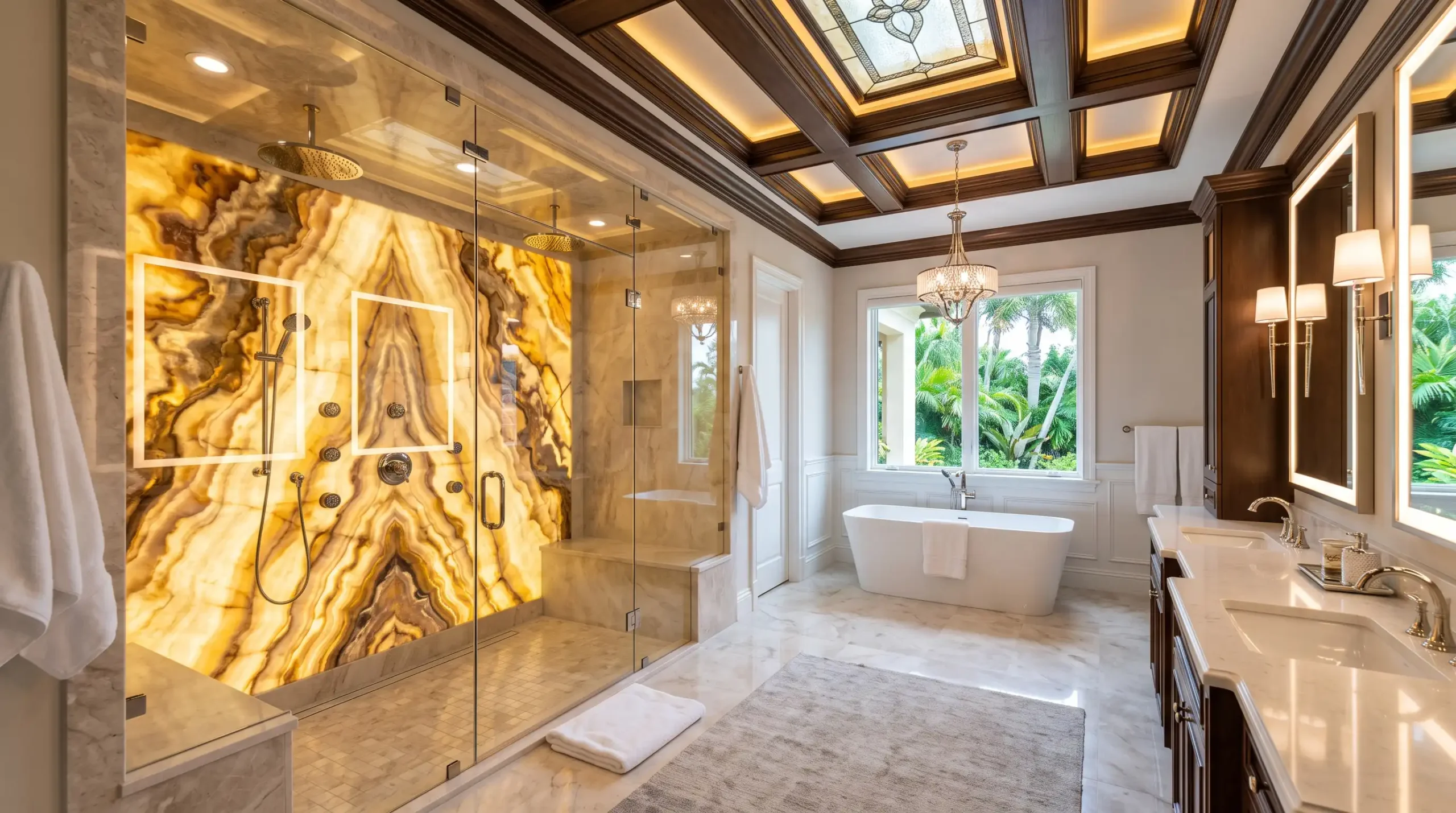
Many Southwest Florida homes have columns that do nothing for the design: square stucco posts at the entry, round columns between the living and dining rooms, or a structural post left standing in an open kitchen. Wrapping them is one of the fastest ways to change the character of a room, because the structural column stays in place and the load path does not change. Interior columns in air-conditioned space are the natural fit for backlit stone, where the lighting can be dimmed for evenings.
Designer Stone Panels are an interior product, so they belong on columns inside the air-conditioned house, not on entry posts, porches or lanais exposed to sun, rain and salt air. If a column shows rot or rust once it is uncovered, that is repaired before the wrap goes on, and structural repairs may need a permit. Uplighting at the base of a stone column, or a cap and base trim in matching stone, finishes the look.
Outdoor Entry and Lanai Columns
Outside, stone on a column is adhered masonry veneer, and the residential code’s veneer rules come with it. The installation practice for manufactured stone, ASTM C1780, covers the lath, scratch coat and mortar, and the code keeps adhered veneer a set distance above soil and paving at the base, at least 4 inches above earth and 2 inches above paved areas on framed walls, so moisture can escape rather than wick up into the stone. Adhered veneer is also limited to roughly 15 pounds per square foot, which is why full-thickness stone on a tall column needs a ledge or footing to sit on.
Water usually gets into an outdoor column from the top. A sloped stone or precast cap with a drip edge sheds rain away from the faces, and the joint where the column meets the soffit or beam above gets a flexible sealant. Near the Gulf, we use corrosion-resistant lath and fasteners, because salt air finds plain steel quickly once the mortar cracks.
Measuring a Column Run
Stone for a column is figured from its faces, not its footprint. A column 16 inches square and 9 feet tall has four faces of 16 inches each, about 5.3 feet of perimeter, so roughly 48 square feet of stone before waste. Add the cap and base, and the corner count, which for a square column is four full-height corners. A pair of entry columns therefore needs as much stone as a modest accent wall, and a run of four in a great room more than most fireplace surrounds. Our LiDAR scan measures every column in the run, so panel counts are exact before the stone is cut.
Column Wrap Questions
Can stone be installed over existing columns?
Yes, in most cases. The existing post stays in place as the structure, and a substrate is built around it to accept the stone. We inspect the column first, because a wood post with moisture damage or a rusting steel column should be repaired before it is covered.
Can a stone column be lit from inside?
With translucent stones like onyx and some marbles, yes. LED lighting sits behind the thin stone so the whole column glows. The design needs a hidden access point for the driver and wiring, which we plan during the 3D render stage.
Are thin stone panels real stone?
Designer Stone Panels are genuine onyx, marble and quartzite cut thin enough to glow when backlit, not printed acrylic or a photo laminate. That is why the veining is unique to each panel and why translucent varieties light up from behind.
Can round columns be wrapped in stone panels?
Flat stone panels cannot bend around a curve, so a round column is usually built out to a square or faceted shape first. If you want to keep the round profile, curved stone or veneer pieces are the alternative, at more cost and weight.
What stone works on outdoor entry columns?
Manufactured or natural stone veneer installed with lath, mortar and proper drainage at the base. Dense stones handle sun and salt air best. Backlit Designer Stone Panels are for interior columns only.
Book a scan and we will render your columns in stone, with or without backlighting, at one fixed price.
Why Stone Projects Start at Cutting Edge
Cutting Edge Kitchen & Bath is the exclusive Florida distributor of Designer Stone Panels, so you can see the actual onyx, marble and quartzite at our 4,000-square-foot showroom at 28280 Old 41 Road in Bonita Springs. As a licensed general contractor, we also handle what sits behind the stone: inspecting the column, building the substrate and running power for backlighting. A free LiDAR scan and photo-real 3D render show your columns before fabrication, and our own crews install them under one fixed-price contract, backed by more than 500 Southwest Florida remodels and nine Best of Houzz awards.