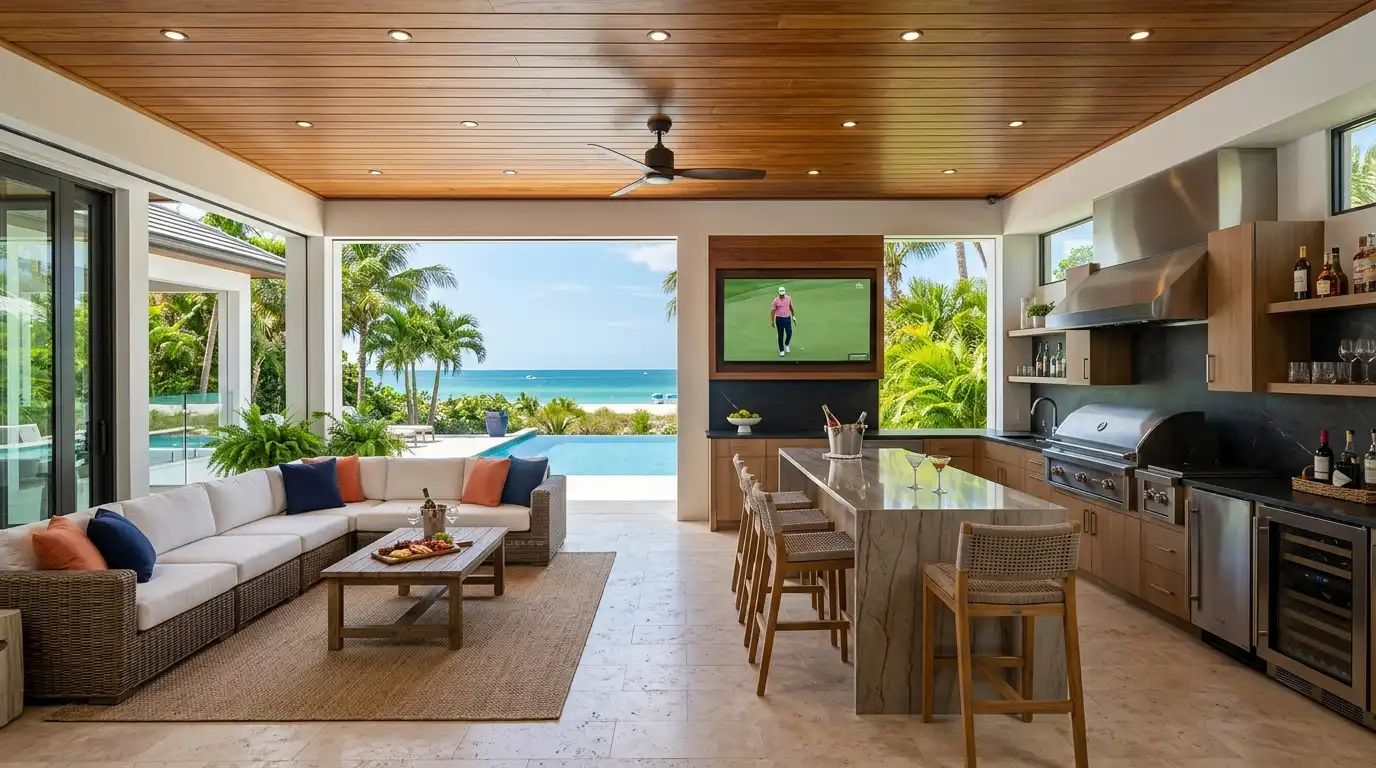
Covered Outdoor Kitchen
Ideas for Florida Homes
The main ways to cover an outdoor kitchen are extending the lanai or house roof, building a freestanding pavilion with a solid roof, or adding a pergola, open or with a louvered aluminum roof. In Southwest Florida any cover has to be engineered for hurricane wind loads and permitted, and a grill under a solid roof needs an outdoor-rated vent hood. Add wet-rated ceiling fans, good lighting and outlets, and the kitchen stays usable through midday sun and afternoon storms.
A roof over the grill changes more than the shade. It decides how smoke leaves, which fan and light ratings are needed, what the fire code allows in a condo, and how much engineering goes into the permit set. This guide walks through the cover types first, then the Florida conditions, hood sizing, fixture ratings, the multifamily grill rule and layout choices under the roof.
What Are the Options for Covering an Outdoor Kitchen?
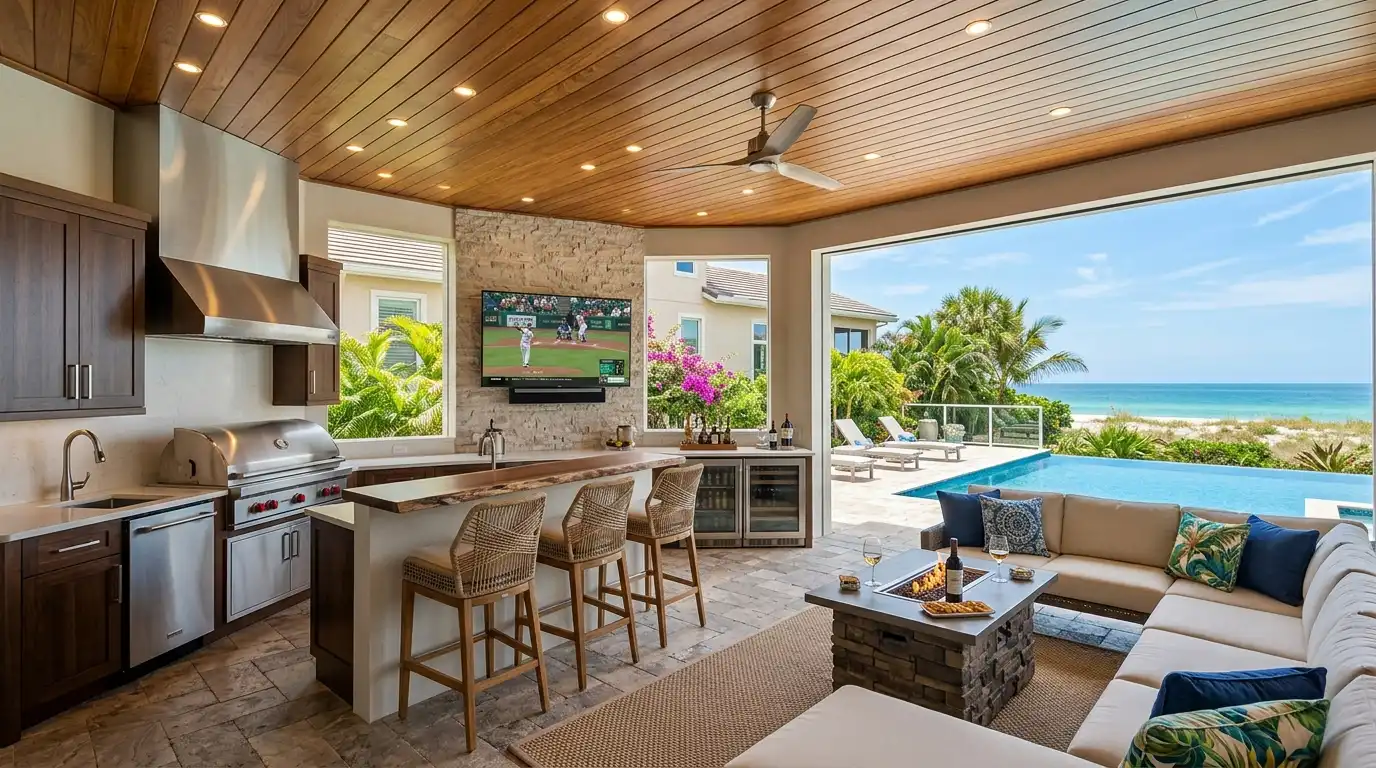
A roof extension ties into the house, so it shares the roofline and can match shingle, tile or metal, and it usually gives the best rain protection because it connects to the existing lanai. A freestanding pavilion works when the kitchen sits closer to the pool or deeper in the yard; it can have its own roof style, ceiling and lighting. Pergolas give shade rather than shelter unless they get a solid or louvered top, and motorized louvers let you open the roof for evening air and close it when a storm rolls in.
Whatever covers it, smoke and heat need somewhere to go. Under a solid roof, a vent hood rated for outdoor use, sized wider than the grill and with enough airflow to beat cross breezes, keeps soot off the ceiling. Grill manufacturers also specify clearances to combustible materials, which shape the ceiling and hood design. Ceiling fans should carry a wet-location rating, lights should be rated for damp or wet locations, and ceilings in aluminum, PVC or treated tongue-and-groove handle humidity better than untreated wood.
| Cover type | Rain protection | Notes |
|---|---|---|
| Roof extension from the house or lanai | Full | Matches the home, needs engineering where it ties in |
| Freestanding pavilion | Full | Good near the pool, own foundation and permit |
| Louvered aluminum pergola | Full when closed | Adjustable shade and airflow, check wind rating |
| Open wood or aluminum pergola | None | Shade only, lowest cost |
| Under an existing screen enclosure | Partial | Screen roof lets rain through, smoke can stain screens |
| Shade sail | Minimal | Usually taken down before storms |
What Changes Under a Southwest Florida Sky?
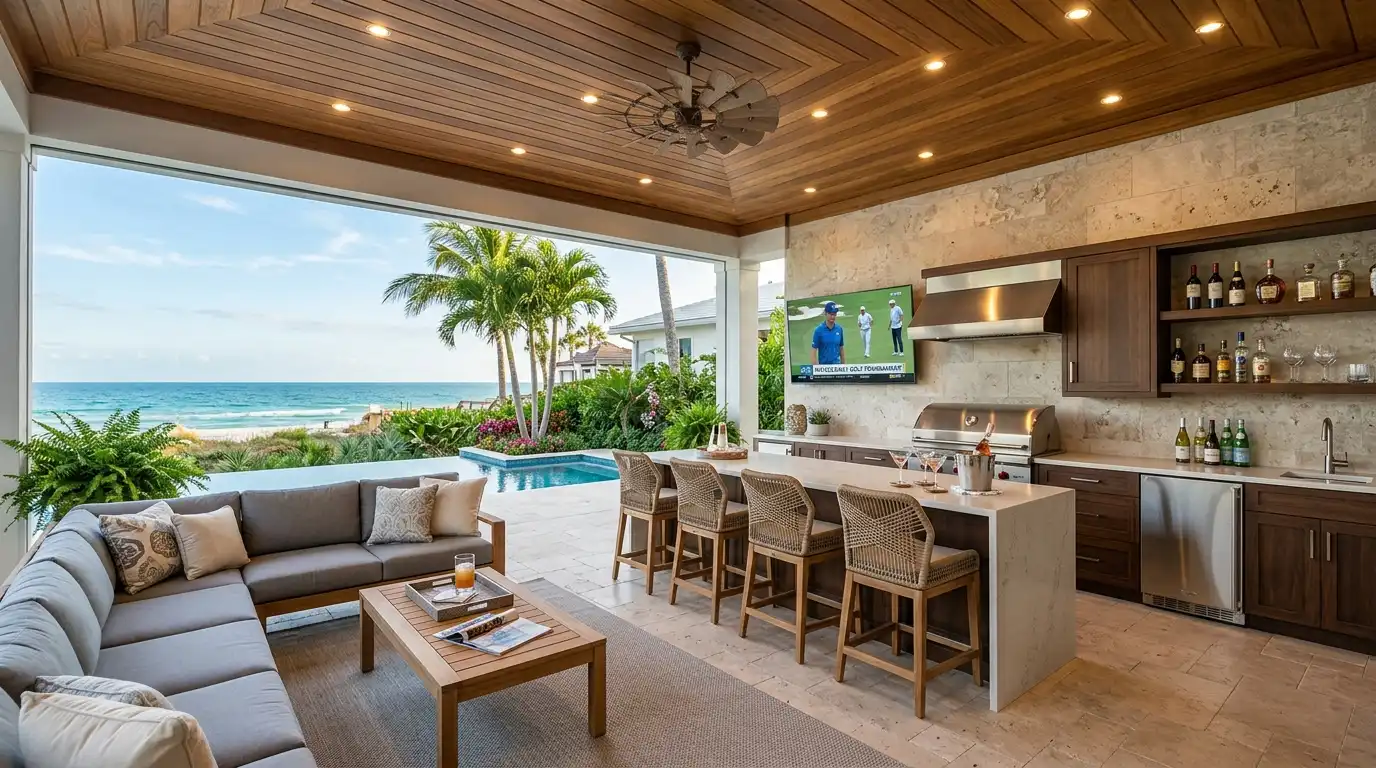
Wind design comes first. Lee and Collier counties sit in high wind zones under the Florida Building Code, so a roof extension or pavilion needs engineered connections, footings and fasteners, and a louvered system needs a product rating for our wind speeds. That means permits from the City of Bonita Springs, Lee County, Collier County or the City of Naples, plus HOA architectural approval in most gated communities, along with setback and lot coverage checks. We draw the cover, the kitchen and the utilities together so one permit set covers them.
Salt air and summer rain shape materials. Near the Gulf, we specify grade 316 stainless appliances and hardware, powder-coated aluminum framing and stone or porcelain counters that do not mind humidity. Fans matter as much as shade in July, and a cover lets you grill through the daily afternoon storms instead of waiting them out. Outdoor kitchen packages start from $18,000, with the roof or pavilion priced from your site plan. For owners who are away during hurricane season, we also plan how louvers, furniture and grill covers get secured.
See our outdoor kitchen packages, from a grill island under the lanai to a full pavilion kitchen.
How Big Should the Grill Hood Be?
Outdoor hoods are sized larger than indoor ones because wind pushes smoke sideways before it can rise. BBQGuys, a large outdoor kitchen retailer, advises a hood that extends past the grill’s cooking surface by 3 inches on each side, reaches as deep as the grill, and moves at least 1,200 cubic feet per minute in any outdoor setting, or roughly 1 CFM for every 100 BTU of burner output if that figure is higher. Proline, a hood maker, goes further and suggests 6 to 12 inches of extra width, noting that a hood the same width as the grill is common but does not ventilate as well.
Mounting height, duct route and the clearance to a wood or vinyl ceiling come from the hood and grill installation manuals, so we pick both appliances before the ceiling is framed. A hood duct that exits through the roof has to be flashed and sealed like any other roof penetration, which is far easier on a new pavilion than on an existing lanai roof.
Fans and Lights: Damp or Wet Rated?
Fixture ratings follow exposure. Hunter Fan describes damp-rated fans as made for covered spaces where moisture hangs in the air but rain does not reach the fan, and wet-rated fans as built to take direct rain, which suits open pergolas and uncovered patios. The same company points out that a fan near the outer edge of a covered patio can still get soaked in a windy storm, and it recommends a wet-rated model there. Our summer squalls blow rain well under most lanai roofs, so we treat the outer few feet of any cover as a wet location.
Lighting follows the same logic. Recessed cans, pendants over a bar and under-counter strips all carry their own damp or wet listing, and coastal homes benefit from finishes made to resist salt corrosion. Plan a switch for the hood light, a dimmer for the dining area and task lighting directly over the grill, where the hood blocks most ceiling light.
Condos and the 10-Foot Grill Rule
Townhome and condo owners face a different limit. The Florida Fire Prevention Code, 8th edition, took effect December 31, 2023, and it adopts NFPA 1. Section 10.10.6.1 says that, for anything other than one- and two-family dwellings, a grill or similar cooking device may not be used or lit on a balcony, under an overhanging portion of the building, or within 10 feet of a structure. A Charlotte County fire marshal letter summarizing the rule notes two allowances: listed electric tabletop grills with no more than 200 square inches of cooking surface, and listed equipment permanently installed according to the manufacturer’s instructions.
In practice that means a gas or charcoal grill under a condo lanai roof is usually off the table, while a single-family pool home can build a covered kitchen within the code limits that apply to houses. Associations often add their own grill rules on top of the fire code, so we read the declaration and talk to the local fire official before designing anything for an attached home.
Laying Out the Kitchen Under the Roof
A few placement decisions make a covered kitchen far more pleasant to use:
- Grill toward the open side. Setting the cooking zone near the downwind or open edge lets breezes carry smoke away from seating and the house.
- Landing space on both sides. Counter room beside the grill gives a spot for platters and tools, and a sink nearby saves trips indoors.
- Ceiling height for the hood. Low lanai ceilings can leave too little room for a proper hood, which may push the grill to a pavilion or a raised ceiling section.
- Utilities before finishes. Gas, the hood duct, fan boxes and conduit go in before the ceiling is closed and counters are set.
- Water off the roof. Gutters and downspouts keep runoff from sheeting onto the counter edge or the pool deck.
Covered Outdoor Kitchen Questions
Do I need a vent hood for a covered outdoor kitchen?
Under a solid roof, yes in practice. Grill manufacturers specify clearances and often require a hood when cooking under a combustible ceiling, and without one smoke and grease stain the ceiling and fans. The hood should be outdoor-rated, wider than the grill and strong enough to pull smoke through a breeze.
Do I need a permit for a pavilion or pergola over my outdoor kitchen?
In Southwest Florida, almost always. Solid roofs, pavilions and louvered systems are structures that must meet wind load requirements, and the gas, electrical and plumbing for the kitchen need permits too. Most HOAs also require architectural approval. We prepare the drawings and handle the permit process.
Can I build an outdoor kitchen under my pool cage?
Many owners do, and it gives the kitchen bug-free surroundings. A screen roof does not keep rain off, and grill smoke and grease can stain screens and framing over time. Placing the grill near an open edge, or adding a solid roof section with a hood over the cooking area, solves most of it.
Should outdoor ceiling fans be damp-rated or wet-rated?
Damp-rated fans suit fully covered spots where rain never reaches the blades. Anywhere wind-driven rain can hit the fan, including the outer edge of a lanai and any open pergola, choose a wet-rated model, and look for corrosion-resistant finishes near the coast.
Can I put a gas grill on my condo lanai?
Usually not. The Florida Fire Prevention Code, through NFPA 1 section 10.10.6.1, bars grills on balconies, under overhangs and within 10 feet of a structure in buildings other than one- and two-family homes. Small listed electric tabletop grills are allowed, and your association may have stricter rules.
Book a free site scan and we will render the kitchen with a roof, pavilion or louvered cover.
Why Outdoor Cooks Choose Cutting Edge
Cutting Edge Kitchen & Bath designs and builds covered outdoor kitchens across Bonita Springs, Naples, Estero and the beaches, with more than 500 Southwest Florida projects and nine Best of Houzz awards. As a licensed Florida general contractor, we handle the engineered roof or pavilion, the gas, electrical and plumbing, and the kitchen itself under one fixed-price contract, built by our own crews. A free LiDAR scan and photo-real 3D render show the cover and kitchen together before permits. Visit our 4,000-square-foot showroom at 28280 Old 41 Road to see materials.