Stone Backsplash
Choosing and Caring for It
A stone backsplash uses natural stone such as marble, quartzite, granite, travertine or onyx on the wall behind a counter, either as tile, as a full-height slab, or as thin stone panels. Full slabs give a continuous look with almost no grout, while tile costs less and suits patterns. Natural stone is porous to varying degrees, so it needs sealing, and the area behind a cooktop needs a stone that tolerates heat and cleans easily after grease. Thin panels make stone possible where weight or thickness is a problem.
Picking the stone is the part everyone enjoys. The details that decide whether a backsplash still looks right in ten years are less glamorous: where the outlets land, what the stone is set in and how close it sits to the burners. This guide walks through those decisions in the order we make them on a Southwest Florida kitchen.
Tile, Slab or Thin Panel?
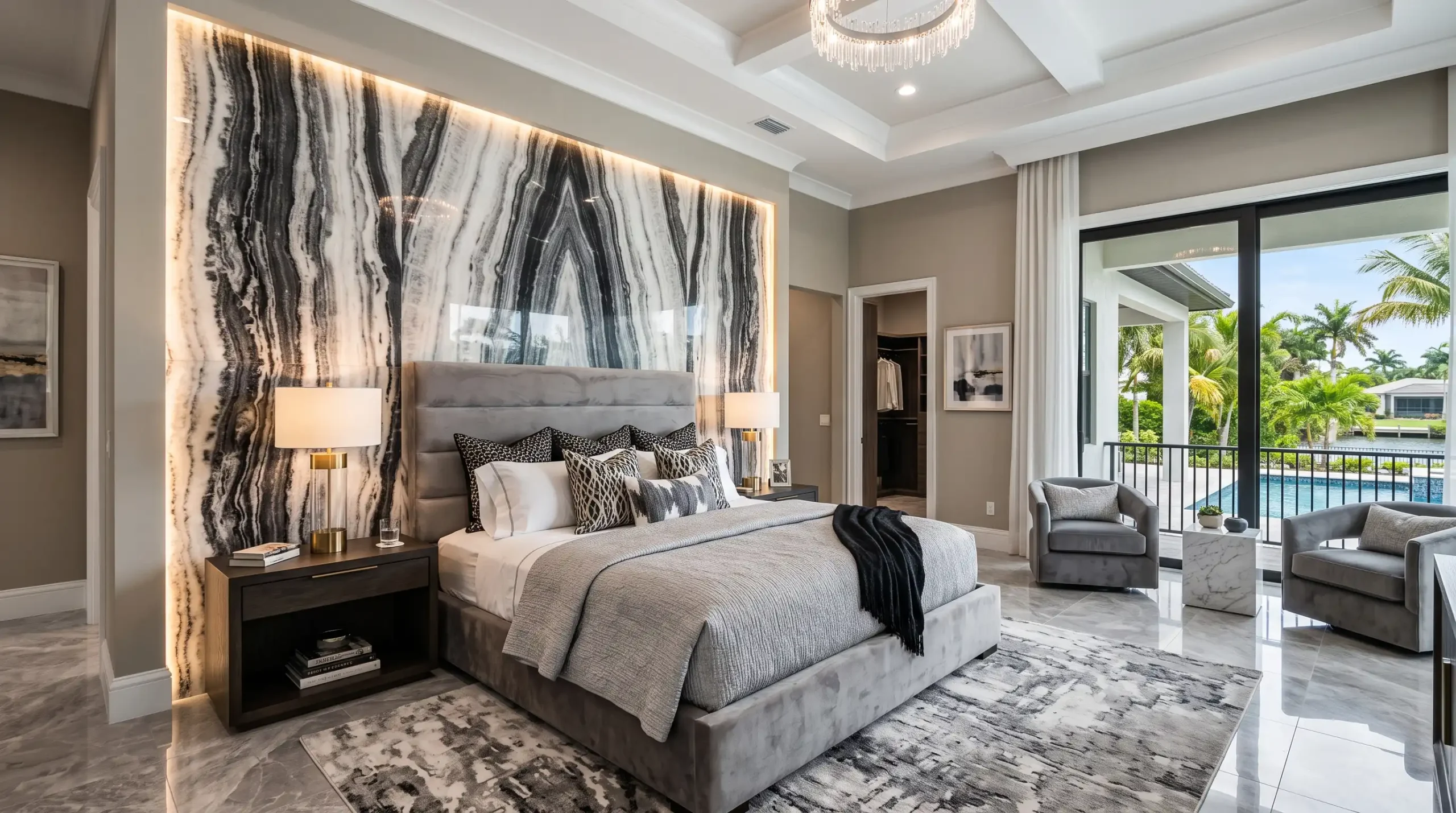
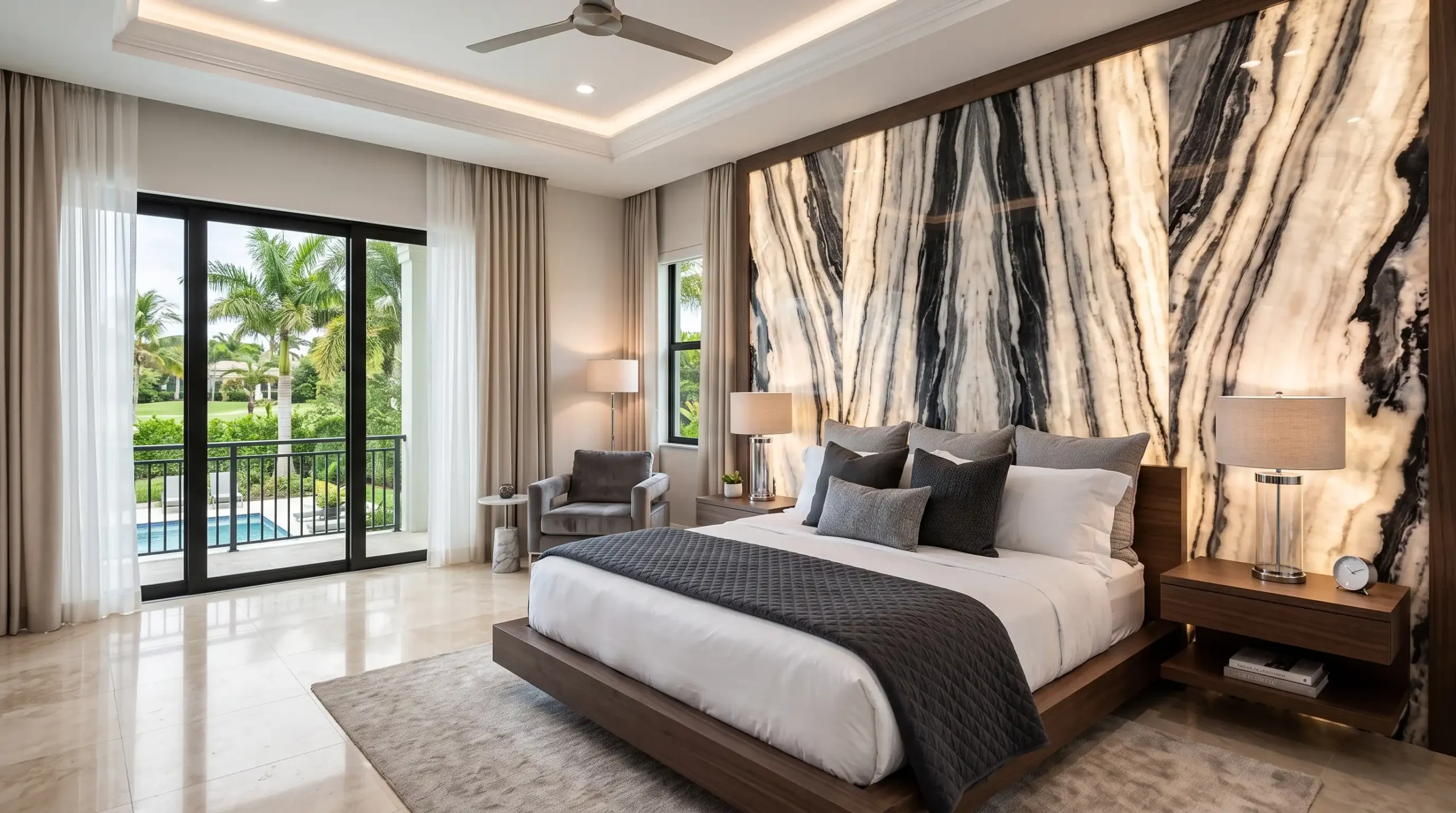
The first choice is format. Stone tile, from subway shapes to mosaics and herringbone, is the most flexible and the easiest to replace. A full-height slab, often cut from the same block as the countertop, reads as one surface and leaves only a few seams to wipe. Thin stone panels, a few millimeters thick and bonded to a backing, bring real stone to areas where a slab would be too heavy, and translucent onyx or marble panels can be backlit so the wall glows at night.
Height is the second decision. With a standard 36-inch counter and upper cabinets hung at 54 inches, the backsplash zone is about 18 inches tall, and a slab or panel covers that span in a single piece with no horizontal joint. Where there are no upper cabinets, such as a range wall with a chimney hood or a window wall with open shelves, many clients run the stone to the ceiling.
Which Stone, and Which Spec?
Stone type drives maintenance. Marble and limestone are soft and react to acids like lemon juice and vinegar, so they etch even when sealed. Travertine has natural voids that are usually filled at the factory. Granite and true quartzite are harder and more resistant to heat and staining, which makes them good choices behind a range. Sealing does not make stone waterproof; it slows absorption so you have time to wipe spills. Grease cleanup is easiest with fewer grout lines, a honed or polished finish rather than heavily textured stone, and a mild pH-neutral cleaner.
| Stone | Hardness and care | Behind a cooktop | Typical format |
|---|---|---|---|
| Marble | Soft, etches with acids, seal regularly | Possible but shows wear | Tile, slab, thin panel |
| Quartzite | Hard, resists heat and scratches, seal | Excellent | Slab, thin panel |
| Granite | Hard and durable, low upkeep when sealed | Excellent | Slab, tile |
| Travertine | Porous with filled voids, seal often | Fair, needs frequent cleaning | Tile |
| Limestone | Soft and porous, seal often | Fair | Tile, slab |
| Onyx | Soft, translucent, can be backlit | Better away from direct heat | Slab, thin backlit panel |
Names on slab-yard tags are marketing; the ASTM specification behind a stone is not. Each family of dimension stone has its own standard for density, absorption and strength:
- Marble: ASTM C503, the specification for marble dimension stone.
- Granite: ASTM C615, which covers granite and the harder igneous stones sold under that name.
- Quartzite: ASTM C616, the standard for quartz-based dimension stone. A stone sold as quartzite that scratches with a knife or etches with a drop of lemon juice is probably a dolomitic marble, and it should be cared for like marble.
- Limestone: ASTM C568.
- Travertine: ASTM C1527, the specification for travertine dimension stone.
See ultra-thin backlit onyx, marble and quartzite panels for backsplashes, feature walls and outdoor kitchens.
Outlets, Switches and the Code
Every kitchen backsplash is also an electrical wall. The Florida Building Code, 8th Edition (2023), adopts the 2020 National Electrical Code, and three of its rules shape a stone backsplash:
- Spacing. Countertop receptacles have to be placed so that no point along the counter wall is more than 24 inches from an outlet, and any counter space 12 inches or wider needs one, under NEC 210.52(C).
- Height. Receptacles serving the counter may sit no more than 20 inches above it, which is why some clients move outlets out of the stone and into a power strip mounted under the upper cabinets.
- Box depth. In a noncombustible wall finish such as stone, NEC 314.20 allows the front edge of an electrical box to sit no more than 1/4 inch behind the finished surface. A 2 cm or 3 cm slab pushes the face well past that, so each box gets an extension ring before the devices go back in.
Kitchen receptacles must also be GFCI-protected under NEC 210.8(A). On a slab backsplash, every outlet and switch opening is cut by the fabricator from the template, so the layout is set before templating and does not move afterward. With heavily veined stone we place the outlets to avoid the strongest vein lines.
Heat and Clearance Behind the Range
Stone itself does not burn, but the wall behind a cooktop sees heat, steam and grease every day. The residential code requires at least 30 inches of vertical clearance between a range top and unprotected combustible material above it, unless a listed hood or appliance allows less, under section M1901.1. Natural stone slab and tile set on cement board are noncombustible. Thin stone panels are bonded to an aluminum composite or PVC honeycomb backing, so behind a gas range we follow the panel and range manufacturers’ clearance guidance rather than treating the panel like solid stone.
Translucent onyx is the stone most likely to show heat marks over time. Our usual approach is a hard quartzite or granite directly behind the range, with backlit onyx used on a bar wall, an island back or the far end of the run, where it gets the attention without the abuse.
What the Stone Is Set In
The setting material matters as much as the stone. Most stone tile and panels go up in a polymer-modified mortar that meets ANSI A118.4 or the higher-performance ANSI A118.15, installed to ANSI A108 methods over cement board or a properly prepared wall. White and light marbles are set in white mortar, because gray mortar can shadow through translucent stone and leave the wall looking blotchy. Some green marbles and other moisture-sensitive stones warp or curl in water-based mortar, so they are set in epoxy or a rapid-setting mortar instead.
Where the backsplash meets the countertop, we leave a small gap filled with a flexible sealant rather than grout. The counter and the wall move independently, and a rigid joint at that corner is usually the first place a stone backsplash cracks.
Florida Kitchens and Outdoor Kitchens
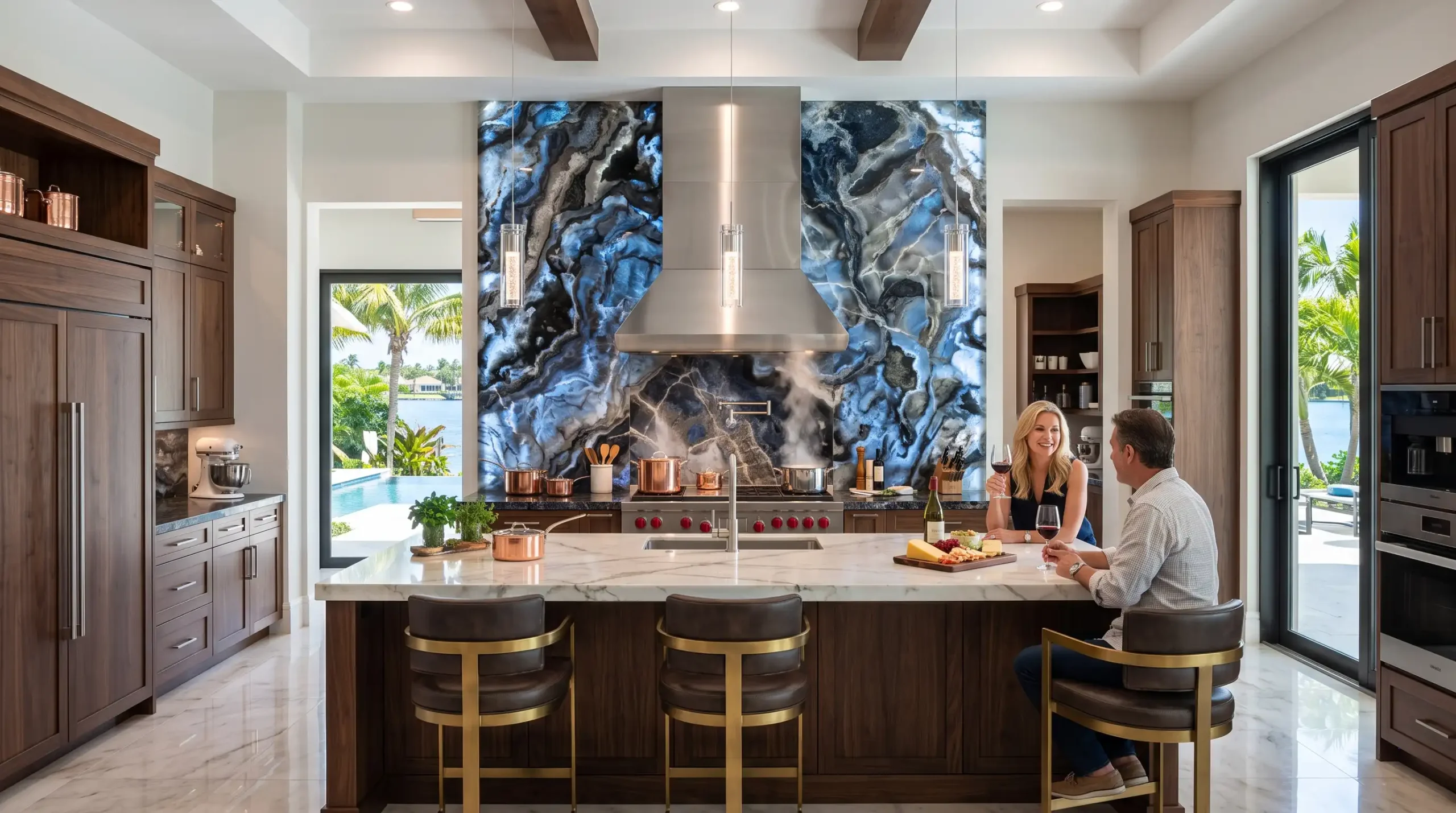
Indoors, Southwest Florida kitchens are open to living areas and get daily use from family and seasonal guests, so a backsplash that wipes clean quickly matters more than an intricate pattern. Full slabs and large panels keep grout lines to a minimum. On the inside face of block exterior walls, the stone is set on cement board or a properly prepared substrate rather than directly on painted drywall. Backlit stone needs its LED power supply accessible, which we plan into an adjacent cabinet.
Designer Stone Panels and backlit onyx are interior-only, so an outdoor kitchen backsplash calls for a different material. Outdoor kitchens on lanais and pool decks face sun, salt air, rain and wind-driven moisture. Dense, hard stones like granite and true quartzite hold up best, while marble and onyx dull and stain outside. Use exterior-rated thinset and grout, stainless fasteners, and a penetrating sealer reapplied on a schedule, more often near the Gulf. Covered lanais in Bonita Springs, Naples, Estero and Fort Myers Beach protect stone from direct rain, but salt still settles on every surface, so rinsing the backsplash after the grill cools keeps it looking new for years.
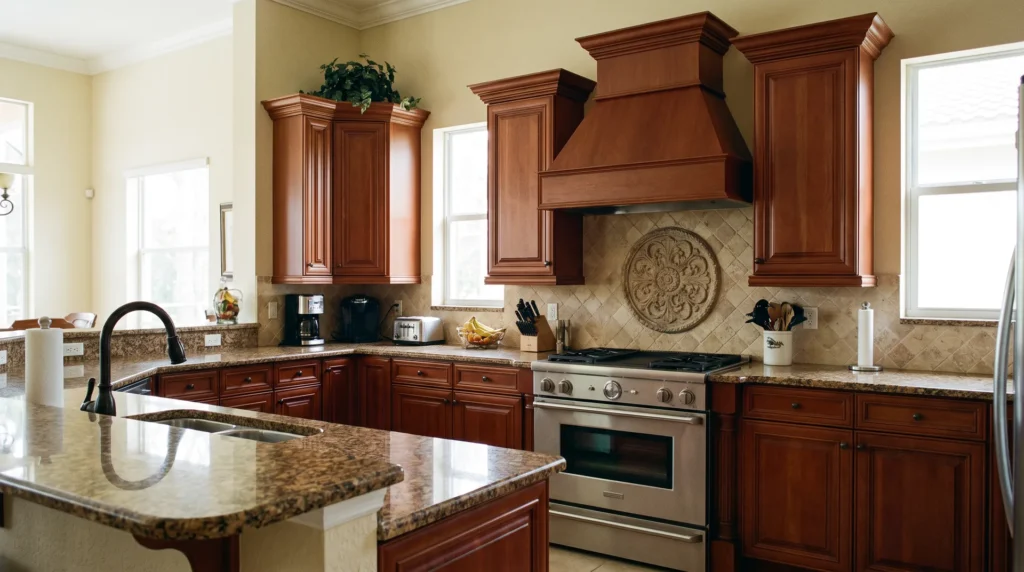
Stone Backsplash Before &
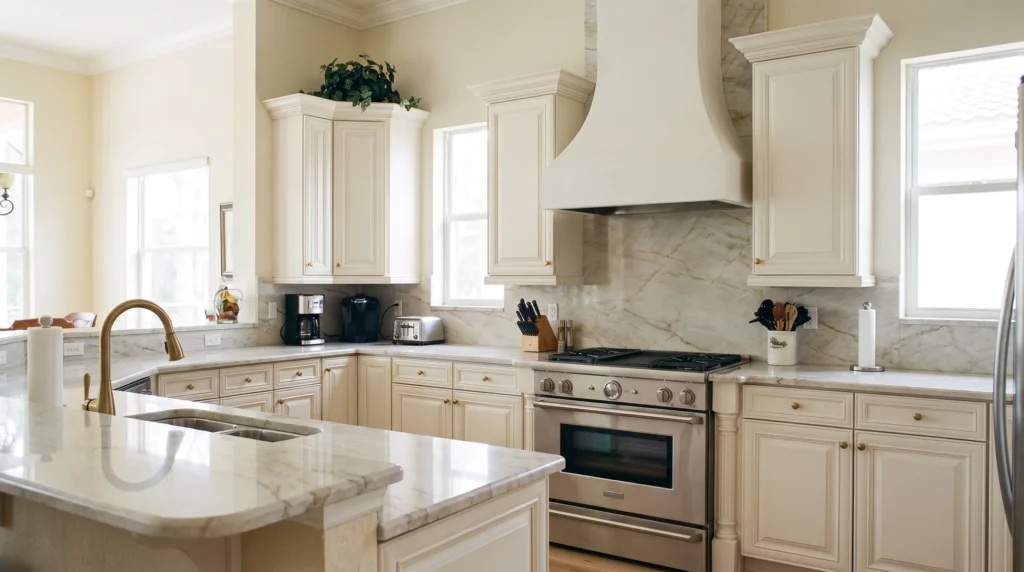
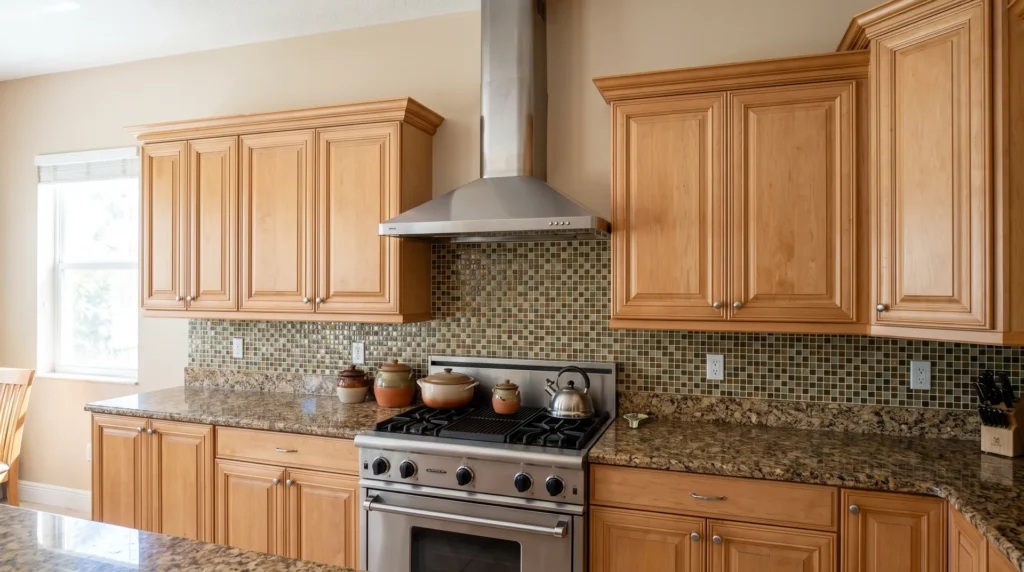
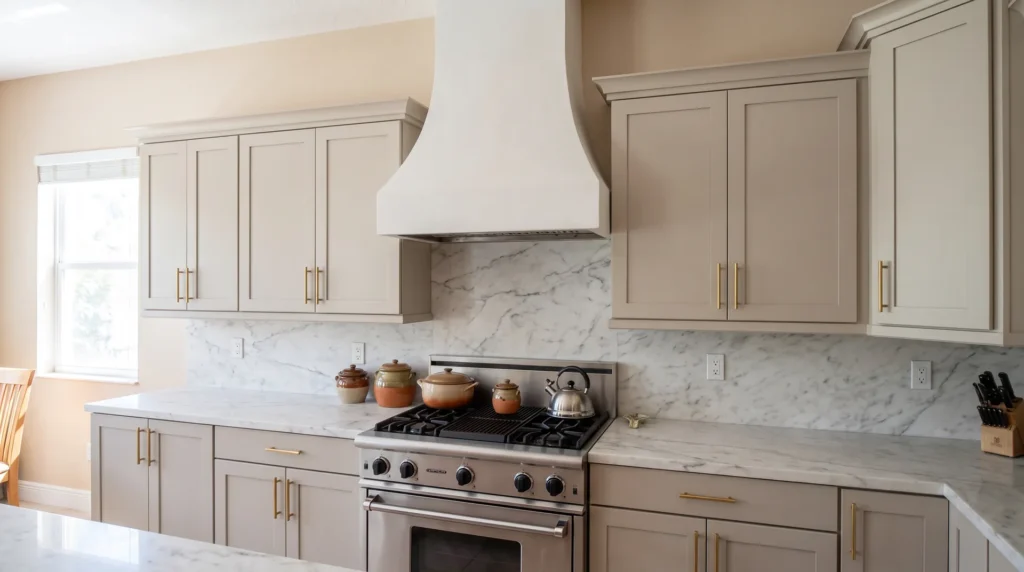
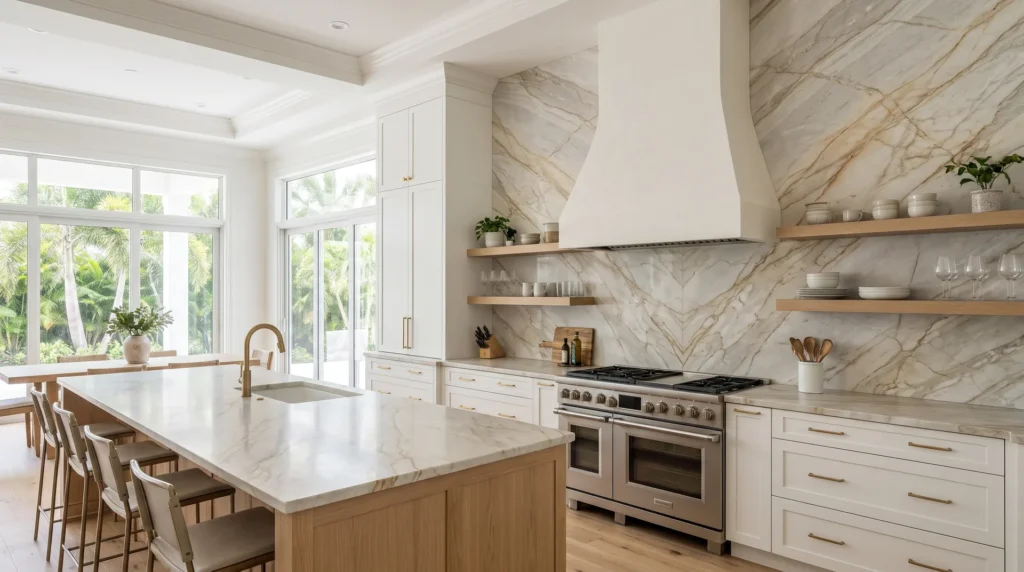
Stone Backsplash Questions
How often should a stone backsplash be sealed?
It depends on the stone and how heavily it is used. Many kitchens reseal marble or travertine about once a year and harder granite or quartzite less often. A simple test: if a few drops of water darken the stone within minutes, it is time to reseal.
Is marble a good backsplash behind a stove?
Marble works, but it etches from acidic splatter and can stain from oil if not wiped promptly. If you love the look, choose a honed finish, seal it well and accept some patina. Quartzite or granite gives a similar look with far less care.
Should the backsplash match the countertop?
It does not have to. Running the countertop slab up the wall creates a continuous, high-end look. A contrasting stone or a backlit panel can also make the backsplash the focal point. We render both versions in 3D so you can compare before cutting.
Do outlets have to go in a stone backsplash?
No. The electrical code allows counter receptacles up to 20 inches above the counter, so they can move into a strip under the upper cabinets, leaving the stone uninterrupted. Islands and walls without uppers still need outlets that meet the code’s island and counter requirements.
How do I know if a quartzite slab is real quartzite?
Real quartzite will scratch glass and will not etch from lemon juice or vinegar. If a sample fails either test, it is likely a dolomitic marble sold under a quartzite name and should be sealed and cleaned like marble.
We scan your kitchen, render the stone options side by side and give you one fixed price.
Why Choose Cutting Edge for Stone Work
Cutting Edge Kitchen & Bath is the Florida exclusive distributor of Designer Stone Panels, the thin backlit onyx, marble and quartzite panels you can see installed at our 4,000-square-foot showroom at 28280 Old 41 Road in Bonita Springs. We also fabricate and install traditional slab and tile backsplashes, so you can compare every format in one place. Our crews have finished more than 500 Southwest Florida remodels and earned nine Best of Houzz awards. A free LiDAR scan and photo-real render come first, then one fixed-price contract and installation by our own crews.