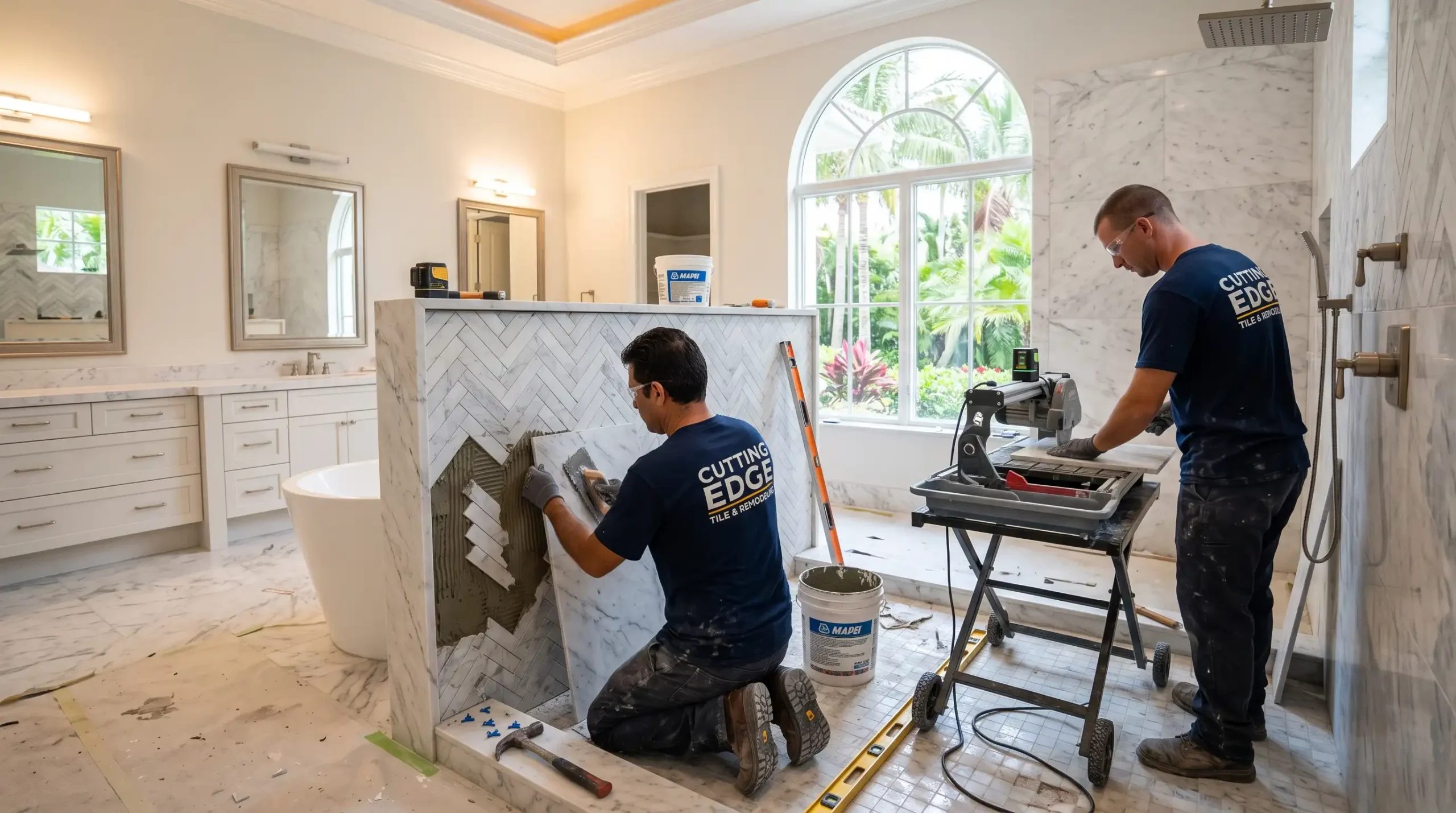
Shower Tile Ideas
That Hold Up in Florida
The best shower tiles for a Southwest Florida home are porcelain, glazed ceramic, glass and well-sealed natural stone, set over a fully waterproofed substrate. Large-format porcelain on the walls means fewer grout lines to clean, while small mosaics on the floor give the grip and flexibility needed to slope toward the drain. Handmade zellige and marble add character but need more care. The look is a matter of taste; performance depends on choosing a tile rated for wet areas and pairing it with the right grout.
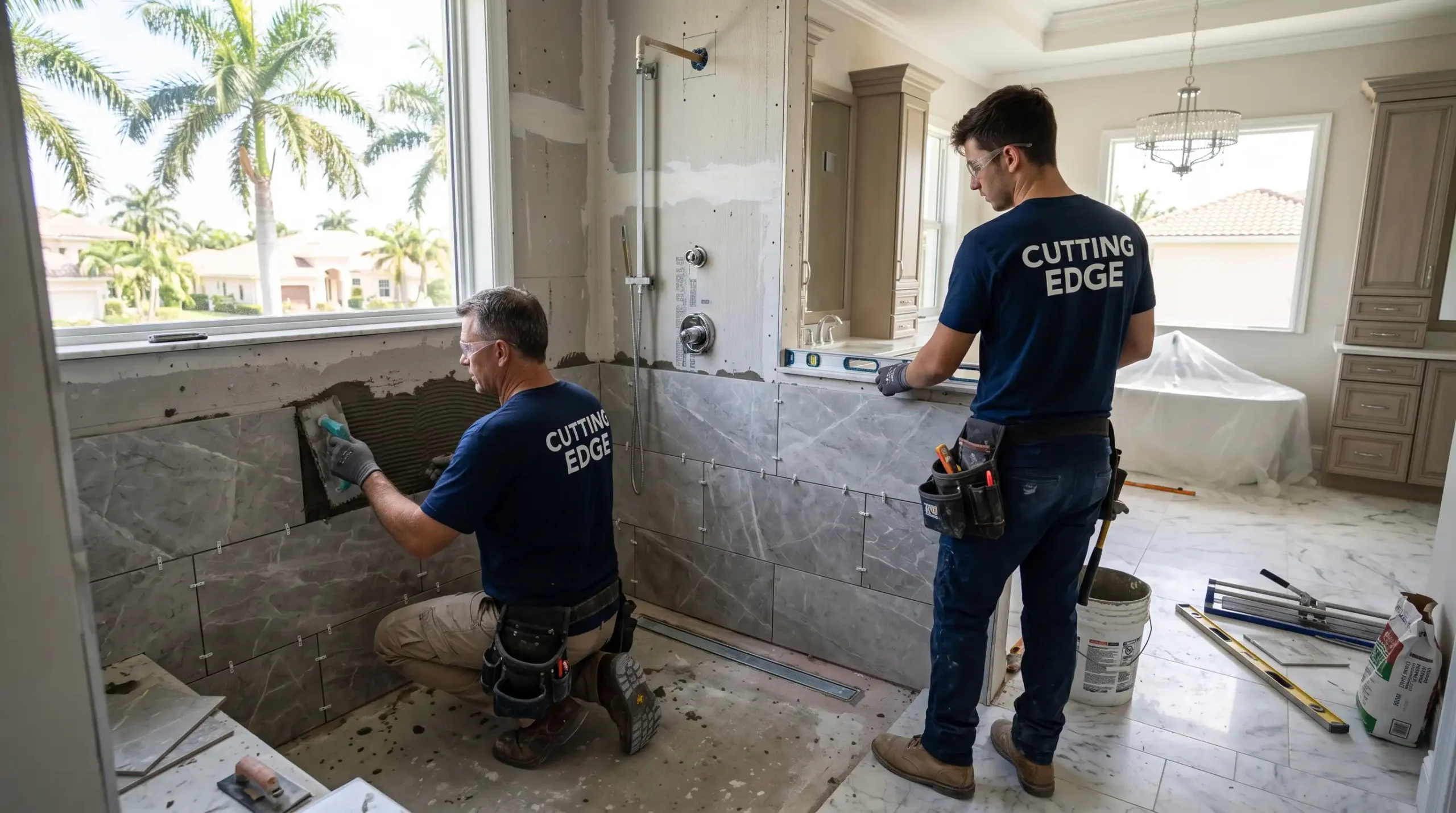
Which Shower Tile Styles Work Best?
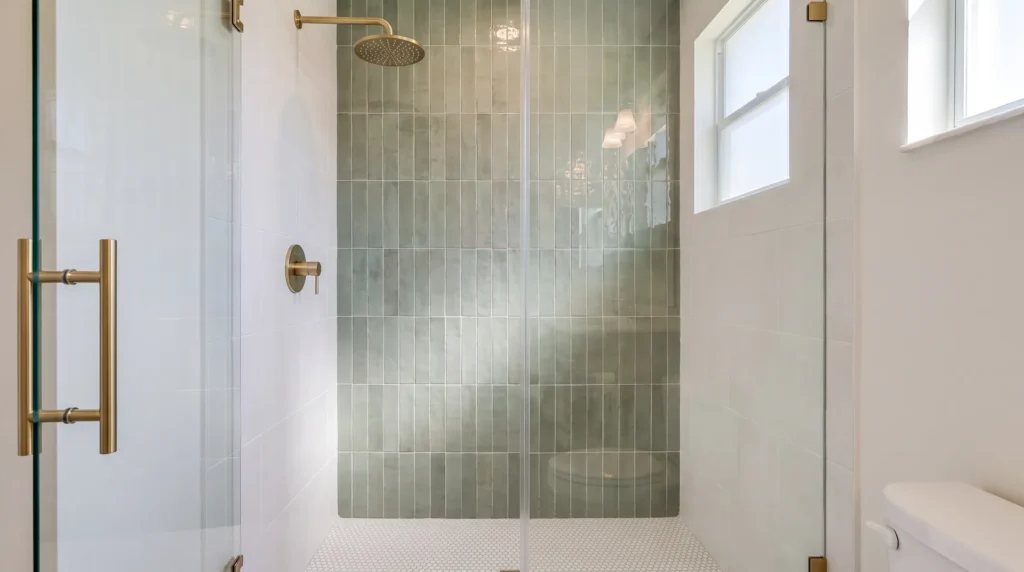
Most current shower designs start with one of four directions. Large-format porcelain, 24 by 48 inches or bigger, gives a calm, almost slab-like wall with very few joints, and many porcelains convincingly mimic marble or concrete. Vertical stacked subway or long rectangular tile makes a low ceiling feel taller. Handmade zellige, glazed terracotta from Morocco, brings uneven color and edges that catch light, and it suits coastal and Spanish-style homes. Natural stone such as marble, travertine or limestone offers depth no printed tile matches.
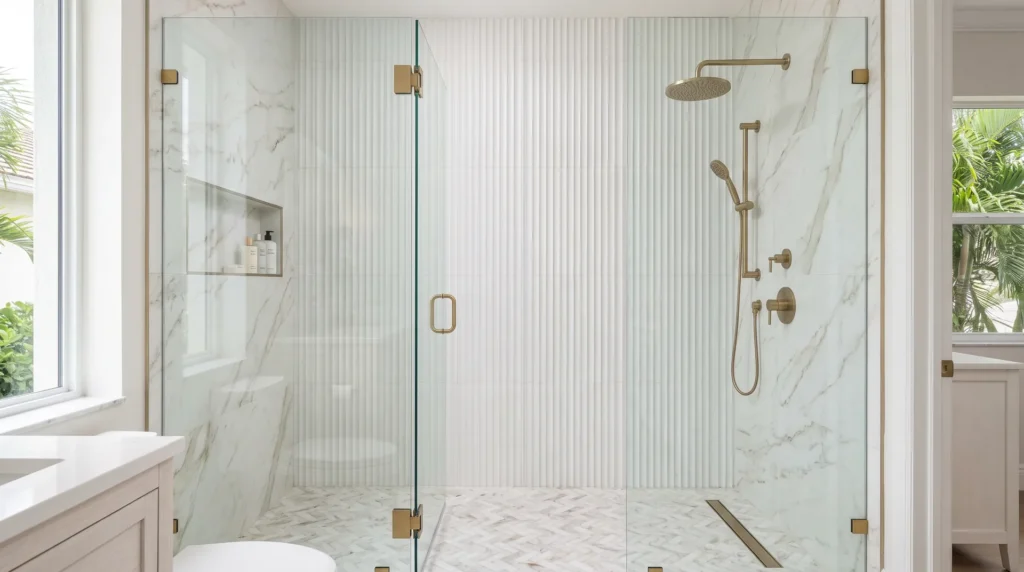
Floors follow different rules. A shower floor has to slope toward the drain, so small tiles like 2-inch hexagons, penny rounds or pebble mosaics bend with the slope, and their many grout joints improve traction. A linear drain lets you run larger tile on the floor because the slope only goes in one direction. Accent ideas include a niche lined in a contrasting mosaic, a single feature wall in stone, or running the floor tile up one wall. Grout matters as much as tile: epoxy or high-performance grout resists stains and mildew far better than standard cement grout.
| Tile | Strengths | Watch-outs | Best use |
|---|---|---|---|
| Porcelain | Dense, very low water absorption, many looks | Large sizes need a very flat wall and skilled setting | Walls and floors |
| Glazed ceramic | Affordable, wide color range | Softer body, not ideal for most floors | Walls and accents |
| Glass mosaic | Reflective, does not absorb water | Shows flaws in the substrate, needs careful setting | Niches and feature bands |
| Zellige | Handmade texture and color variation | Irregular edges, chips easily | Feature walls |
| Marble | Classic veining, natural depth | Etches with acidic cleaners, needs periodic sealing | Walls, niches, floor mosaics |
| Travertine or limestone | Soft, warm texture | Porous, must be filled and sealed | Walls in lightly used baths |
Explore walk-in, curbless and tub-to-shower conversions, each flood-tested before tile and finished with frameless glass.
What Changes in a Florida Shower?
Humidity is the hidden test. In Southwest Florida the bathroom rarely dries out completely, so grout lines and porous stone stay damp longer and mildew has more time to settle in. That is the practical argument for large porcelain, epoxy grout and a good exhaust fan on a timer. Tile itself does not waterproof a shower, because water passes through grout, so everything depends on the membrane behind it. We use a continuous bonded waterproofing system and flood-test the pan before any tile goes down.
Seasonal living changes maintenance too. A shower that sits closed up for five months while the owners are up north needs materials that tolerate neglect, which favors porcelain and glass over unsealed stone. Coastal homes on Bonita Beach or Fort Myers Beach see more salt and sand tracked in, so a textured floor finish and stain-resistant grout earn their keep. If you love marble, use it where it gets wiped down often, and choose a honed finish on the floor so it is less slippery when wet.
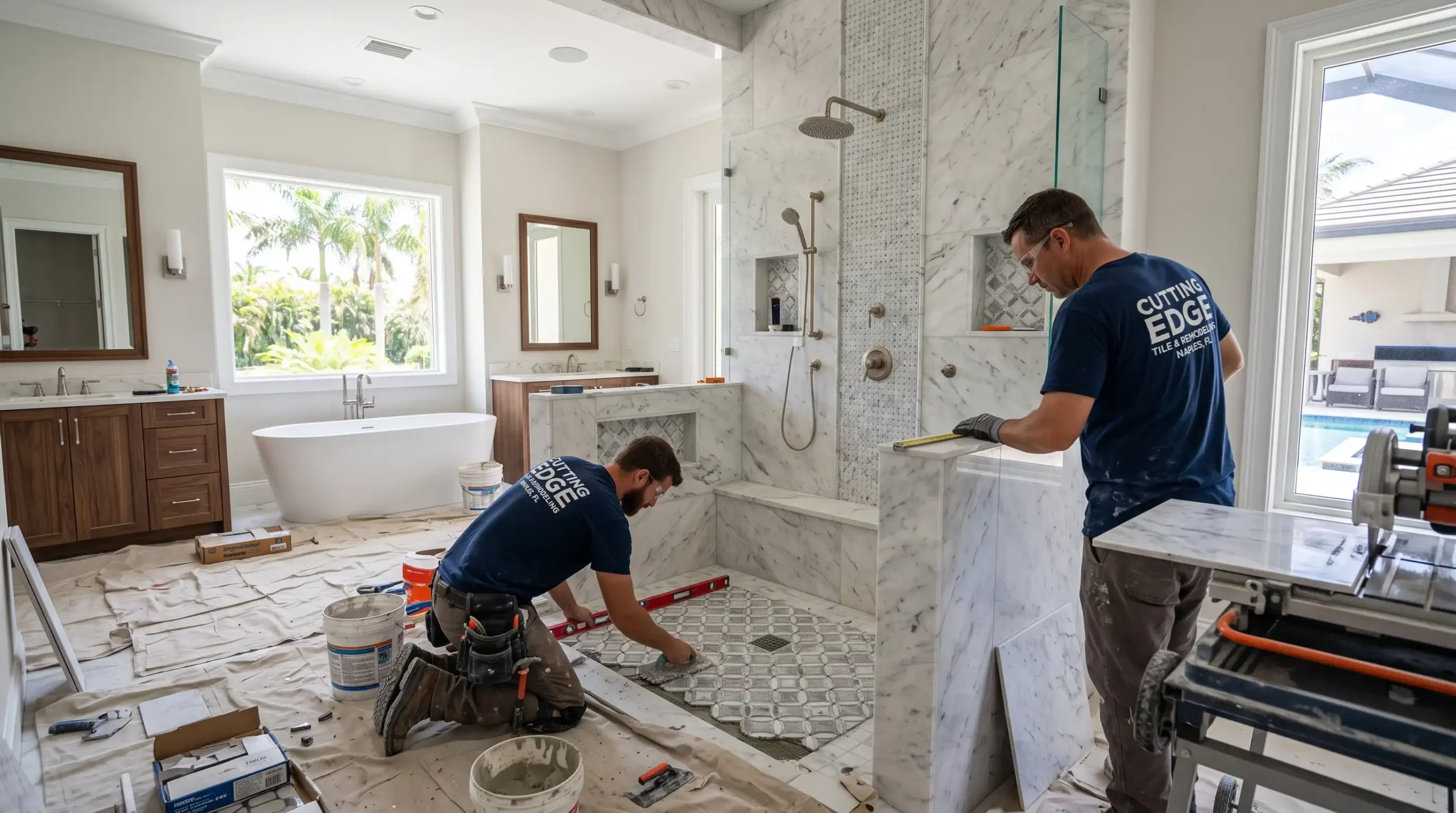
Slip Resistance, Grout and Waterproofing for Shower Tile
Tile is the layer everyone sees, but the choices that decide whether a shower is safe and lasts are mostly technical: how slip resistance is measured, what a spec sheet means by porcelain, how flat a wall must be before large tiles go up, which grout resists stains, and how the waterproofing is tested. This section collects those questions with the standards and manufacturer guidance behind them. Several figures come from trade articles that summarize standards, not the standards themselves, so confirm anything that matters for your building with your installer and your local building department.
How Is a Shower Tile’s Slip Resistance Measured?
Daltile’s DCOF page explains that DCOF, or dynamic coefficient of friction, is the primary product performance measure used to identify suitable floor applications. It says ANSI A137.1 requires tile flooring products to have a DCOF of 0.42 or greater for level interior spaces intended to be walked upon when wet, and that the specification is based on wet DCOF measurement performed according to ANSI A326.3. The page also cautions that the measurements should not be considered an indicator of whether a slip can occur. In other words, the number is a way to compare products under the same test and not a guarantee for your bathroom, with its soap film, bath oils and hard-water residue.
For a shower, that means asking for the wet DCOF value on the manufacturer’s data sheet for any tile you plan to use on the floor, and treating wall tile and floor tile as separate decisions. A tile can be beautiful on the wall and the wrong choice underfoot. The data sheet is also a good place to confirm the tile is rated for interior wet areas at all.
What Size Tile Belongs on the Shower Floor?
A Houzz guide to shower floors says shower floor tiles should be no larger than 6 by 6 inches, with 4 by 4 inches or smaller recommended. One reason it gives is that small tiles leave enough grout lines underfoot to provide traction, and another is that small tiles are needed to cover a sloping floor. It defines mosaic as 2 by 2 inches or smaller, typically sold on mesh or paper backing, and says pebbles make a good shower floor because they are naturally slip-resistant and feel nice underfoot. If you love a large tile on the walls and want a matching floor, the guide’s suggestion is to have the installer cut the large tile down.
The Tile Letter and Fine Homebuilding articles on curbless showers add one exception. A linear drain with a single sloping plane, pitched at one quarter inch per foot, lets a builder use large-format tile on the floor, because the slope only runs in one direction. That is a layout decision made before the tile is chosen, so raise it at the design stage and not at the tile showroom.
What Does Porcelain Mean on a Spec Sheet?
A blog post from the American National Standards Institute explains that porcelain is a variant of ceramic tile and, under ANSI A137.1, a ceramic tile with a water absorption of 0.5 percent or less. It says that level of absorption is measured under ASTM C373-18, which covers water absorption, bulk density and porosity of ceramic tile. The post does not call porcelain waterproof, and the distinction matters in a shower. A low-absorption tile resists soaking up water, but water still travels through grout joints, which is why the membrane behind the tile does the waterproofing. The Tile Letter article describes a thin, load-bearing membrane meeting ANSI A118.10 that goes directly beneath shower floor tile.
How Flat Does a Wall Have to Be for Large Tile?
A Construction Specifier article summarizing ANSI A108.02-2023 says that for tiles with at least one edge of 15 inches or longer, the maximum allowable variation from the required plane is not more than 1/8 inch in 10 feet, while for tiles with all edges shorter than 15 inches it is no more than 1/4 inch in 10 feet. It says allowable lippage, the height difference between adjacent tile edges, is 1/32 inch plus the tile’s inherent warpage for grout joints under 6 millimeters, and 1/16 inch plus the allowable warpage for joints 6 millimeters or wider. For running-bond patterns with a side over 15 inches, it says the grout joint must average at least 1/8 inch for rectified tiles.
The same article notes that lippage requirements do not apply to tiled floors sloping to drains for tiles 6 by 6 inches and larger, and warns that the larger the tile surface, the greater the potential for lippage in those conditions. Its author never recommends joints narrower than 4 millimeters. These are one writer’s summaries of the standard, so verify against the current text. The practical questions to put to an installer are how they will check wall flatness before setting, what joint width they plan to use for your tile, and what they will do about a wall that is out of plane.
Which Grout Should You Choose?
LATICRETE’s guide to epoxy grout says it is typically made of epoxy resins and a filler powder and that, unlike cement-based grout, it is non-porous, making it highly resistant to stains, chemicals and moisture. It says epoxy grout does not require periodic sealing and tends to be much more color consistent. The trade-offs it lists are a higher initial cost than cement grout, a faster set that demands efficient and precise application, and the fact that cement grout is more forgiving for non-professionals.
If you are using a cement-based grout, Granite Gold’s stone care guidance says grout absorbs water, is especially prone to mold, and that sealing the grout lines is crucial. In a humid room, a grout that takes up less water is easier to keep dry, and a cement grout needs a maintenance plan you will actually follow.
What Does Natural Stone Need in a Shower?
Granite Gold’s guidance says marble in a shower needs to be sealed and that the bottom line is frequent sealing. It says polishing a marble to a high gloss reduces its porosity and makes it less sensitive to water stains, that lighter colored stone requires more frequent sealing and is more susceptible to staining and etching, and that rough or textured tiles may need resealing more often. The sealer is often penetrating but not permanent, and in areas with hard water the page recommends applying sealer often to prevent mineral stains. If you choose stone, ask the installer for the sealer product, the application schedule and a stone-safe cleaner in writing.
How Should the Waterproofing Be Tested Before Tile?
TEC Specialty Products calls flood testing a best practice for shower tile installations. It describes plugging the drain with a mechanical pipe plug, building a temporary dam, filling it with water from another source and not from the shower, and recording the water level, the process and several photos. The water sits for 24 hours before it is checked, and the whole process can take as long as 48 hours. A standard test fills to the dam height, which might be 3 inches, while zero-entry showers may require testing 2 inches above the high point of the floor, and local plumbing code sets the exact height. TEC also says to allow a minimum of 12 hours for the membrane to cure after the final coat and to coordinate timing with the local plumbing inspector.
Noble Company says flood tests are generally 24 hours, that the pan is filled to the top of the rough threshold, and that major plumbing codes require tiled showers to be flood tested. It adds that most leaks occur at the drain and suggests checking the local inspector’s requirements, since rules vary by area. Ask your contractor to tell you when the test will run, who will see it and how the result will be documented before any tile is set.
Condominium and Permit Questions for a Tiled Shower
Florida Statutes 718.113(2)(a) says there shall be no material alteration or substantial additions to the common elements, with 75 percent of the total voting interests required where the declaration has no procedure, and subsection (3) says a unit owner shall not do anything within the unit that would adversely affect the safety or soundness of the common elements. Whether a shower rebuild touches a common element depends on your declaration, so get the association’s alteration rules in writing. Under Florida Statutes 718.111(11)(f), association property coverage excludes floor, wall and ceiling coverings, built-in cabinets and countertops within the unit that serve only that unit, so ask your own insurer how new tile would be covered.
For permits, the Village of Estero lists its Community Development, Building and Permitting office at 9401 Corkscrew Palms Circle, Suite 101, 239-221-5036, and the City of Fort Myers lists Building, Permitting and Inspections at 1825 Hendry Street, 239-321-7925. Lee County Community Development at 1500 Monroe Street, 239-533-8585, covers unincorporated Lee County only, and Bonita Springs, Estero and Fort Myers apply with their own municipality. Ask which office handles your address and whether a tile-only refresh versus a rebuilt shower pan changes what needs a permit.
A Checklist for Choosing Shower Tile
- The wet DCOF value for any floor tile, from the manufacturer’s data sheet.
- Floor tile size, and whether a linear drain makes a larger floor tile practical.
- Whether porcelain is rated to ANSI A137.1 for the use you intend.
- The grout type, joint width and wall flatness plan for large tiles.
- The stone sealer and reseal schedule, if you choose marble or limestone.
- When and how the flood test will be done and documented.
- For condos: the association’s written rules and your insurance review.
Shower Tile Before &
Shower Tile Questions
What is the easiest shower tile to keep clean?
Large-format porcelain with narrow grout joints and an epoxy or high-performance grout. Fewer joints mean fewer places for soap film and mildew to settle, and porcelain absorbs almost no water. A squeegee after each use and a fan on a timer do the rest.
Is zellige tile good for a shower?
Yes, on walls, as long as it is set by an installer who understands its irregular edges and the joints are grouted and sealed properly. Expect some chips and color variation as part of the look. We usually keep it off the shower floor.
Do I need to seal marble in a shower?
Yes. Marble is porous and should be sealed after installation and resealed periodically, following the sealer maker's guidance. Use pH-neutral cleaners, since acidic products and many bathroom sprays etch the surface and dull the polish.
What DCOF should shower floor tile have?
Daltile’s DCOF page says ANSI A137.1 requires tile flooring products to have a DCOF of 0.42 or greater for level interior spaces intended to be walked upon when wet. The page cautions that the result compares products and does not predict whether a slip will occur.
How big can shower floor tile be?
A Houzz shower floor guide says floor tile should be no larger than 6 by 6 inches, with 4 by 4 inches or smaller recommended, partly so grout lines provide traction. A linear drain with a single slope can allow larger floor tile, so confirm with your installer.
Is epoxy grout better than cement grout in a shower?
LATICRETE says epoxy grout is non-porous, resists stains, chemicals and moisture, and does not require periodic sealing. It also lists a higher initial cost and a faster set that demands precise application, so cement grout stays easier for non-professionals.
How long is a shower flood test?
TEC Specialty Products says the water sits for 24 hours before checking and the process can take up to 48 hours, with timing coordinated with the local plumbing inspector. Noble Company says flood tests are generally 24 hours and that major plumbing codes require tiled showers to be flood tested.
Pick two or three tile ideas and we will render them in your actual shower before demo day.
Why Bonita Springs Trusts Cutting Edge
Tile is the part of a shower everyone sees, but the waterproofing underneath decides whether it lasts. Cutting Edge Kitchen & Bath flood-tests every pan before tile, sets it with our own crews, and brings both into one fixed-price contract. Our 4,000-square-foot Bonita Springs showroom lets you handle porcelain, stone and mosaic samples side by side, and a free LiDAR scan feeds a photo-real 3D render so you see the pattern in your space first. With more than 500 Southwest Florida remodels and nine Best of Houzz awards, we know which tiles age well here.
Key Takeaways
- Large-format porcelain, 24 by 48 inches or bigger, gives walls a calm, slab-like look with very few joints.
- A Houzz guide says shower floor tiles should be no larger than 6 by 6 inches, with 4 by 4 inches or smaller recommended.
- The Tile Letter and Fine Homebuilding describe a linear drain pitched at one quarter inch per foot, which lets builders use large-format tile on the shower floor.
- LATICRETE says epoxy grout is non-porous, highly resistant to stains, chemicals and moisture, and does not require periodic sealing.
- TEC Specialty Products recommends flood testing the shower pan for 24 hours, with a minimum of 12 hours for the membrane to cure after the final coat.