Outdoor Kitchen Countertops
Built for Florida Sun
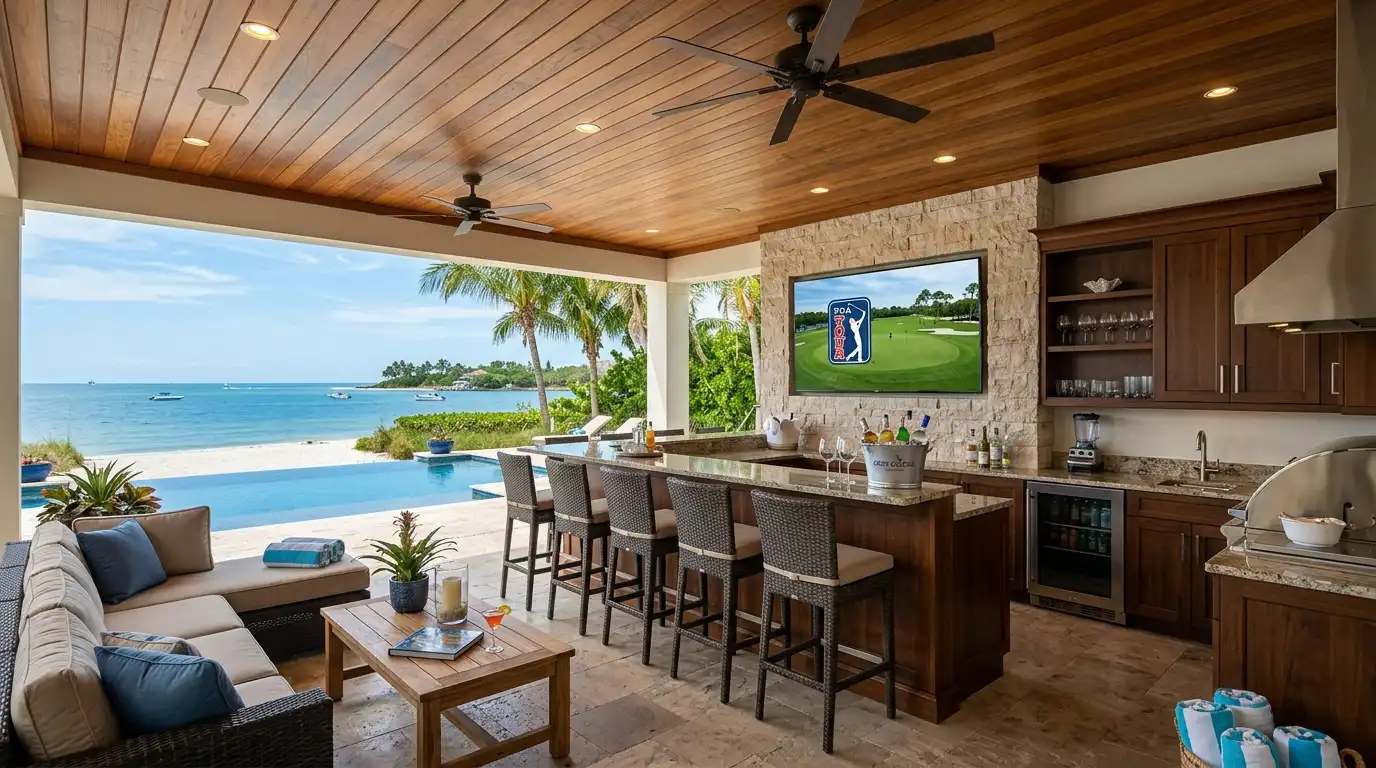
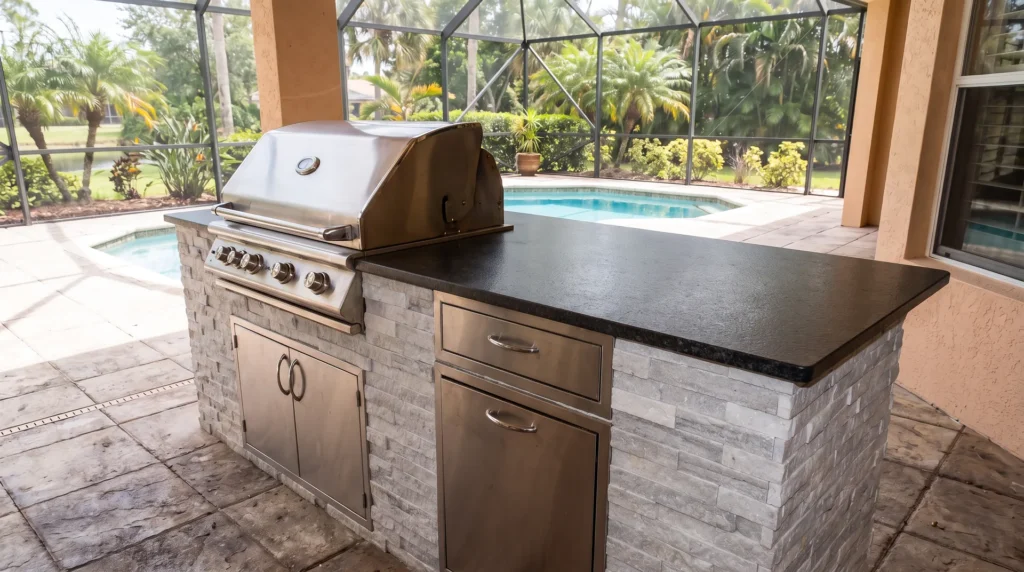
The best outdoor kitchen countertops for Southwest Florida are granite, quartzite and porcelain slabs. All three tolerate UV, heat and rain without fading, though natural stone should be sealed. Concrete works with good sealing and upkeep. Engineered quartz is the one to avoid outdoors, because its resin binders can discolor in direct sun. Color matters too: dark counters in full sun get uncomfortably hot, so lighter or honed finishes are often the better choice on an uncovered patio.
Picking the slab is only part of the job. The grill cutout, the edge profile, the outlets along the backsplash and the way rain runs off the front all have to be settled before templating. The sections below follow that order: material, Florida exposure, the sun-rated engineered options, cutouts and overhangs, utilities, then upkeep.
Which Countertop Materials Hold Up Outdoors?

Granite is the long-time standard. It is dense, handles heat from a grill, and once sealed resists stains from oil, wine and citrus. Quartzite looks closer to marble but is hard and UV stable, which makes it a favorite for covered lanais where people want a lighter, veined look. Porcelain slabs are a newer option: thin, light, nonporous, colorfast and heat resistant, with patterns that mimic marble, concrete or wood. Their weak point is the edge, which can chip if struck, so a mitered or eased profile is worth the detail.
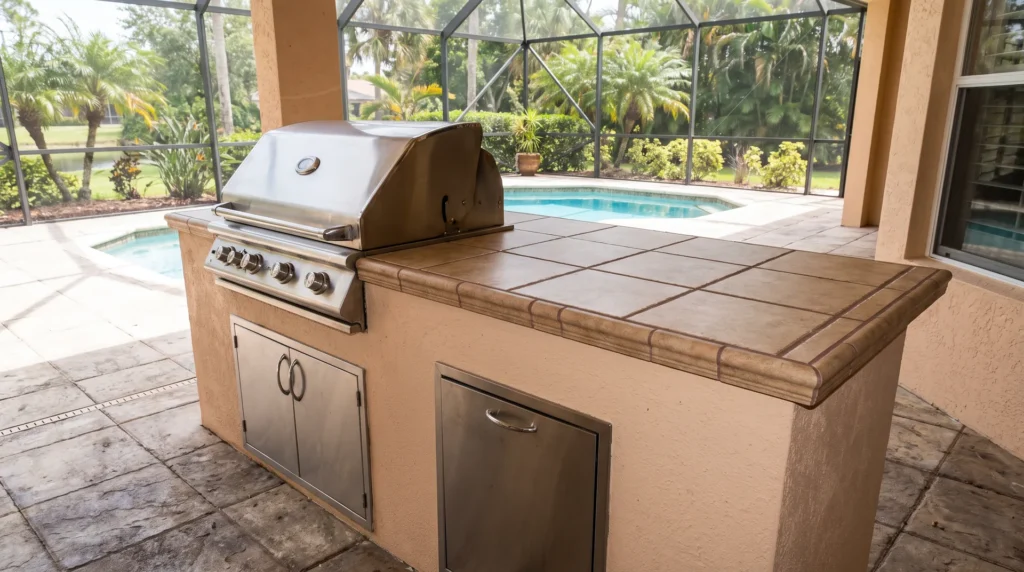
Concrete counters can be cast in any shape and tinted to match the house, but they need a quality sealer, periodic resealing and a plan for hairline cracking. Marble and limestone are soft and etch from acids, so most outdoor designers avoid them. Tile counters cost less, yet the grout lines collect grease and mildew. Beyond material, think about thickness and support: heavy stone needs a solid masonry or steel base, seating overhangs need proper brackets, and the slab must be cut precisely around the grill, side burners and sink.
| Material | UV and heat | Maintenance | Watch for |
|---|---|---|---|
| Granite | Excellent | Seal periodically | Dark colors get hot in full sun |
| Quartzite | Excellent | Seal periodically | Confirm it is true quartzite, not marble |
| Porcelain slab | Excellent, colorfast | Very low, nonporous | Edges can chip on impact |
| Concrete | Good | Seal and reseal | Hairline cracks, stains if unsealed |
| Engineered quartz | Poor in direct sun | Low | Resin can yellow or fade outdoors |
| Marble | Fair | High | Etches from citrus, wine and some cleaners |
What Works Best in Southwest Florida?
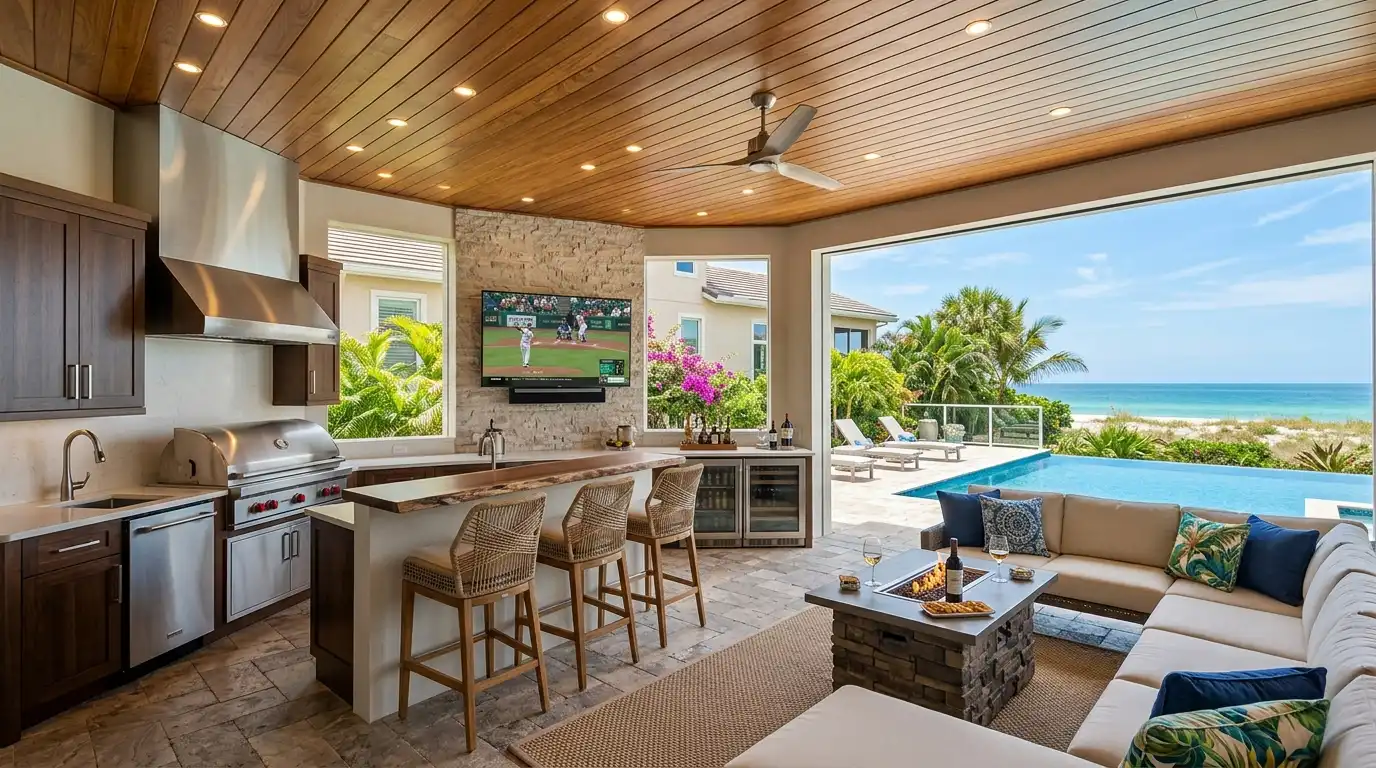
Outdoor kitchens here face months of strong sun, summer downpours, high humidity and, near Bonita Beach and Fort Myers Beach, salt air. Under a covered lanai, nearly any good natural stone or porcelain performs well, and quartzite is a common pick for its looks. On an uncovered pool deck, we steer clients toward lighter granite, porcelain or a honed finish, because a black polished slab in July sun can become too hot to lean on. Sealed surfaces also resist the mildew that grows quickly in our climate.
The counter is only as good as the base under it. Steel studs with cement board and stucco, masonry, or 316 marine-grade stainless cabinetry handle Florida conditions far better than wood framing, which rots and attracts termites. Countertops should overhang the cabinets enough to shed rain and be secured to the base. If your screen enclosure or HOA has rules about grills and structures, we handle the approvals. Our outdoor kitchen packages start from $18,000, and the counter material is one of the biggest choices in the design.
Compare our outdoor kitchen packages and the counter, cabinet and appliance options built for Florida weather.
Engineered Surfaces Rated for Sun
The warning about quartz applies to standard indoor slabs. Caesarstone, for example, states that most quartz surfaces are made for indoor use and that UV exposure outside will fade and weaken them, and it sells a separate Outdoor collection that it describes as UV certified. If you love the uniform look of quartz, ask for the exact product line and read its warranty for exterior use before ordering.
Sintered or ultracompact surfaces are a second engineered route. Cosentino markets Dekton, made by compacting and sintering mineral particles, for outdoor kitchens, citing its resistance to UV rays, heat and staining and its very low porosity. Like porcelain, these slabs are thinner than typical granite and are usually mitered at the edge to look thicker, so edge detailing and careful handling during installation matter as much as the material itself.
Cutouts, Edges and Overhangs
The grill is the fixed point every other measurement is taken from, so we need its specification sheet before the slab is templated. Built-in grill makers list the exact cutout size and say whether the island must be noncombustible or whether the grill needs an insulated jacket. A few details make outdoor tops last longer:
- Seams. Keep joints away from the grill opening and out of the main prep area, where heat and spills concentrate.
- Drip edge. A shallow groove cut under the front edge of an overhang stops rainwater from running back along the underside and staining the cabinet face.
- Overhangs. Bar seating needs a deeper overhang than a standard counter; beyond the limit the fabricator sets for that stone and thickness, add steel brackets or a supported knee wall.
- Edges. Eased, rounded or mitered edges resist chipping better than sharp square profiles, which matters most with porcelain.
Outlets, Gas and Water at the Counter
Most outdoor kitchens add receptacles for a refrigerator, a blender or lighting. The electrical code requires GFCI protection for outdoor receptacles at a home, and receptacles exposed to rain must be weather-resistant types under a cover that stays weatherproof with a cord plugged in, often called an extra-duty in-use cover. Plan where those boxes sit on the backsplash or cabinet face so the stone cutouts line up and the covers can open fully.
A natural gas or propane line to the grill and a drain for an outdoor sink are permitted work, done by licensed trades and inspected before the counters are set. Running them before the base is built avoids cutting into finished stucco or masonry later.
Keeping Outdoor Counters Looking New
Upkeep is simple when it is regular. Wipe grease and citrus off natural stone promptly, use a pH-neutral cleaner instead of vinegar or bleach, and reseal granite or quartzite when water stops beading. Near the coast, a quick rinse with fresh water removes salt film and pollen that dull a surface over time. Fitted covers for the grill help too, though the counter itself can stay uncovered if the material was chosen for full sun.
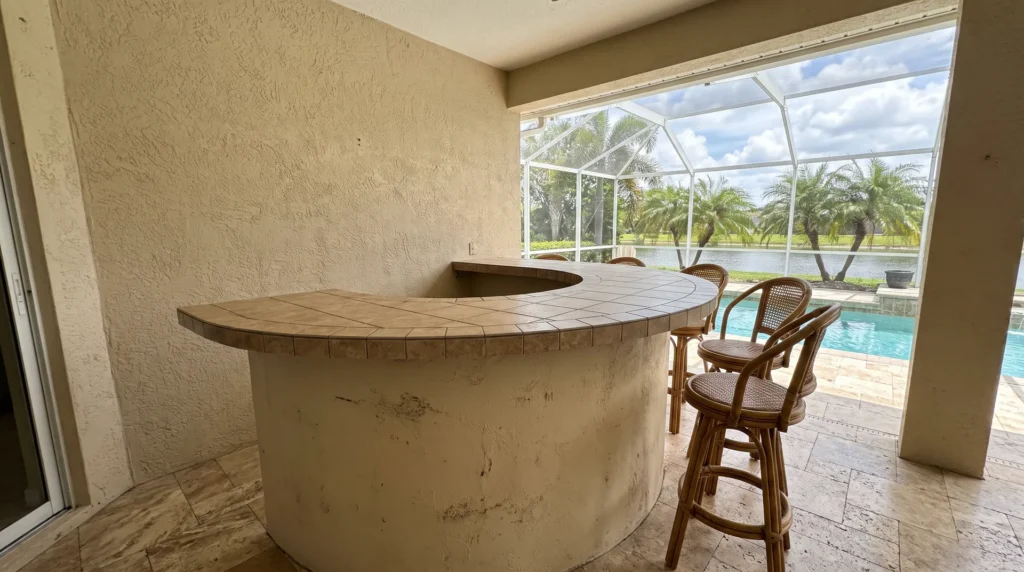
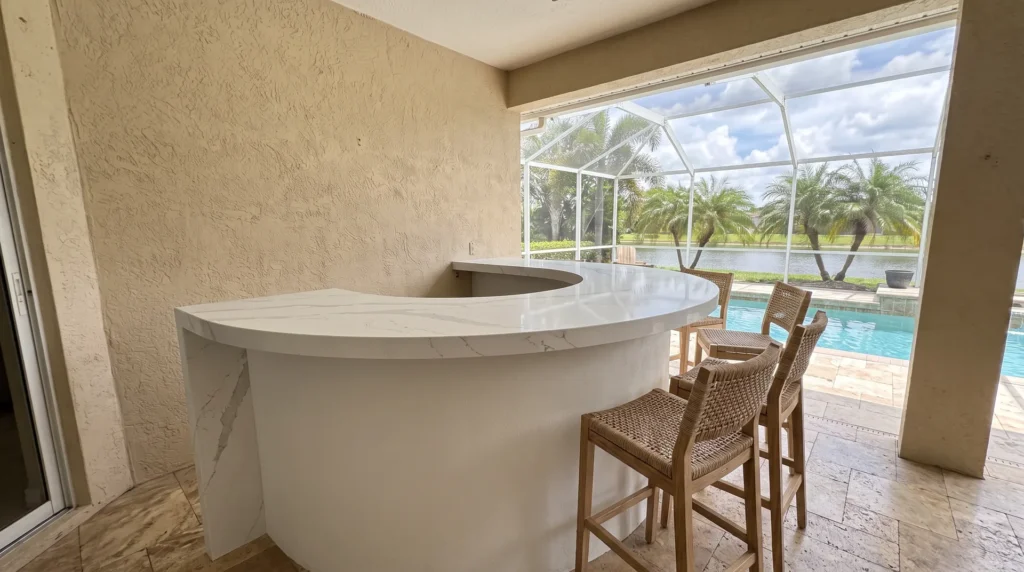
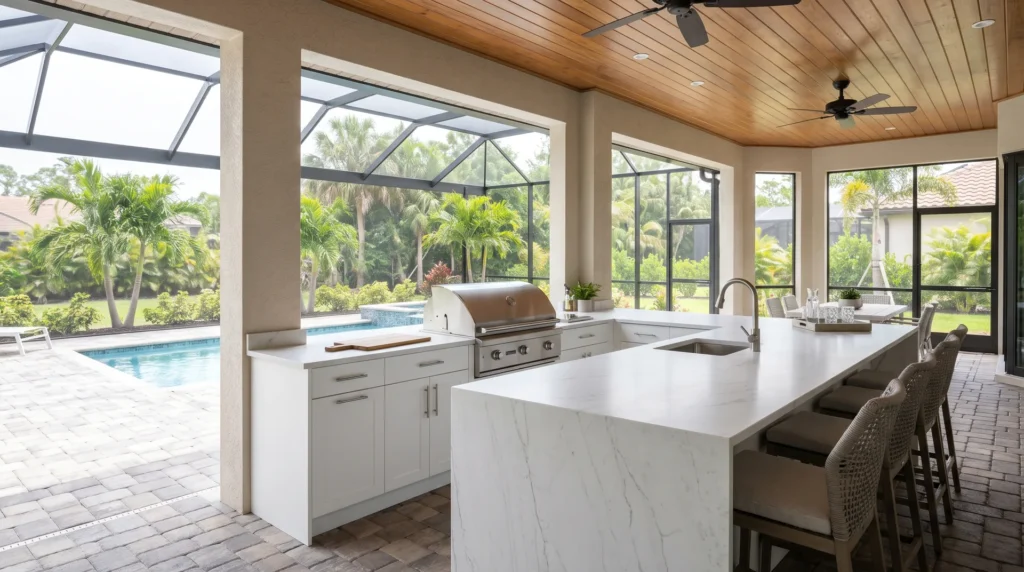
Outdoor Kitchen Countertops Before &
Outdoor Countertop Questions
Can I use quartz countertops in an outdoor kitchen?
Many quartz manufacturers do not warranty their slabs for outdoor use, because the resin that binds the stone can discolor or fade under UV exposure. Under a fully shaded lanai the risk is lower, but for a Florida outdoor kitchen we usually recommend porcelain, granite or quartzite instead.
Do outdoor granite countertops need to be sealed?
Yes, most granite benefits from sealing, especially lighter and more porous stones. Sealing helps resist grease, wine and sunscreen stains. How often depends on the stone and its exposure, and a simple water test tells you when it is time: water should bead on the surface rather than darken the stone.
What is the best countertop color for an outdoor kitchen in full sun?
Lighter colors stay cooler and hide water spots and pollen better. Dark polished stone absorbs heat and can become hot to the touch in direct summer sun. If you love a dark look, a honed or leathered finish under a covered area is the practical compromise.
Do outdoor kitchen outlets need GFCI protection?
Yes. Receptacles outdoors at a home need GFCI protection, and those exposed to rain must be weather-resistant types with an in-use cover that stays closed around a plugged-in cord. New circuits also need an electrical permit.
Is porcelain or granite better for an uncovered pool deck?
Both handle Florida sun. Porcelain is nonporous and never needs sealing but can chip at the edges, while granite is thicker and tougher at the edge but needs periodic sealing. Choosing a lighter color matters more than the material for keeping the surface comfortable to touch.
Send photos of your lanai and we will scan it, render each counter option and quote one fixed price.
Why Lanai Owners Rely on Cutting Edge
Outdoor counters fail when the material or the base was chosen for looks alone. Cutting Edge Kitchen & Bath builds outdoor kitchens for Southwest Florida sun, salt air and storms, pairing stone and porcelain that handle UV with cabinetry that will not rot. Slabs and finishes can be compared side by side in our 4,000-square-foot showroom at 28280 Old 41 Road in Bonita Springs. With more than 500 remodels behind us and nine Best of Houzz awards, we know which surfaces last on a lanai. Each outdoor kitchen begins with a free LiDAR scan of your lanai and a photo-real 3D render, and our own crews build it under a single fixed-price contract.