Frameless Shower Doors
Glass That Lasts in Florida
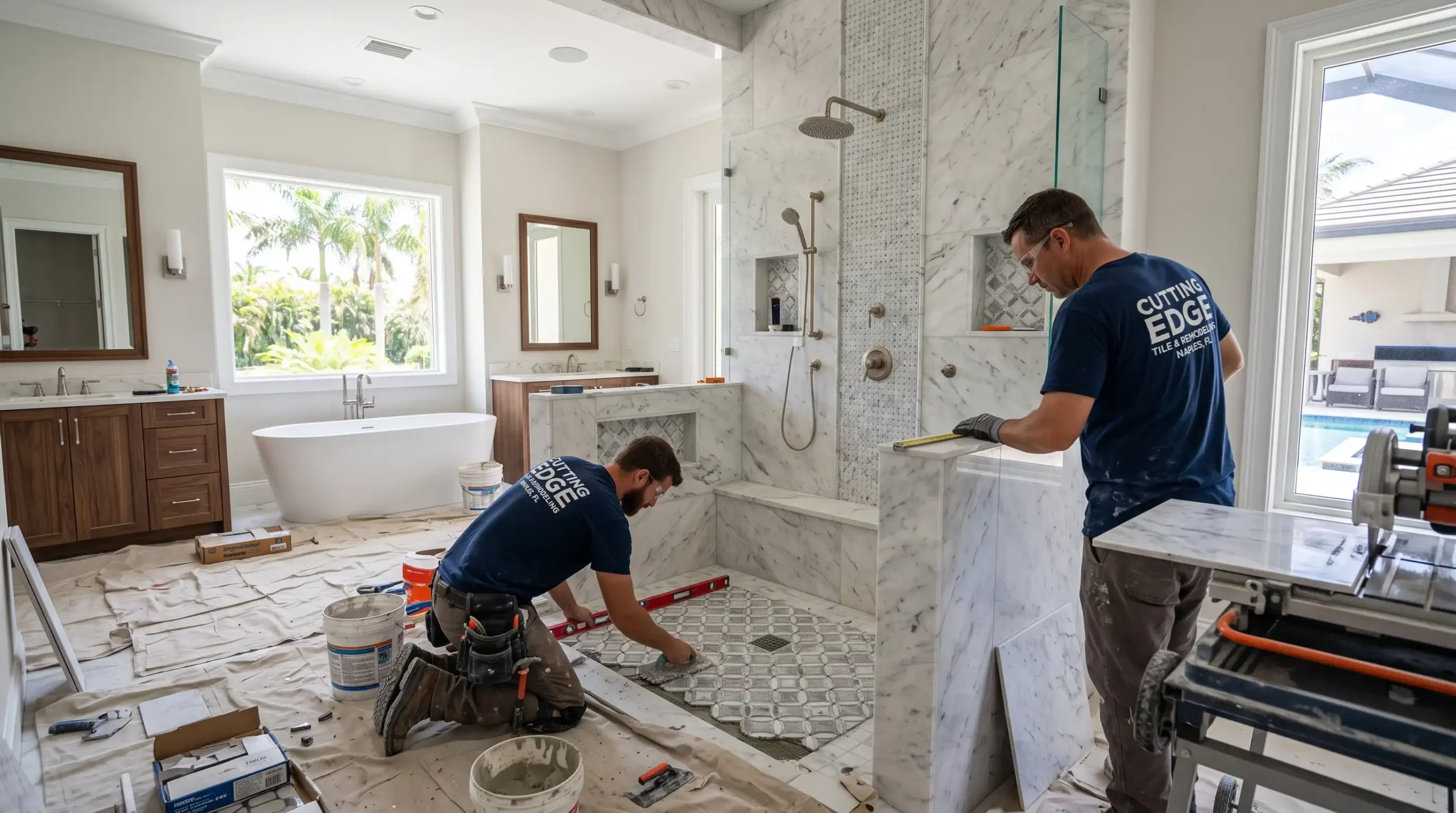
Frameless shower doors are panels of thick tempered glass, usually 3/8 or 1/2 inch, held by a few hinges and clips instead of a metal frame. They look cleaner and are easier to keep clean than framed doors, but they need precise measuring, solid blocking in the wall behind the tile and a level, square opening. Semi-frameless doors use thinner glass with metal on some edges and cost less. In Southwest Florida, ask for a factory protective coating, because hard water spots uncoated glass quickly.
Below the comparison you will find what the safety-glass rule really requires, why tempered panels occasionally fail, what hinges can carry, how door swing and opening width are set, and how to care for glass and hardware in hard water and salt air.
How Do Frameless and Semi-Frameless Doors Compare?
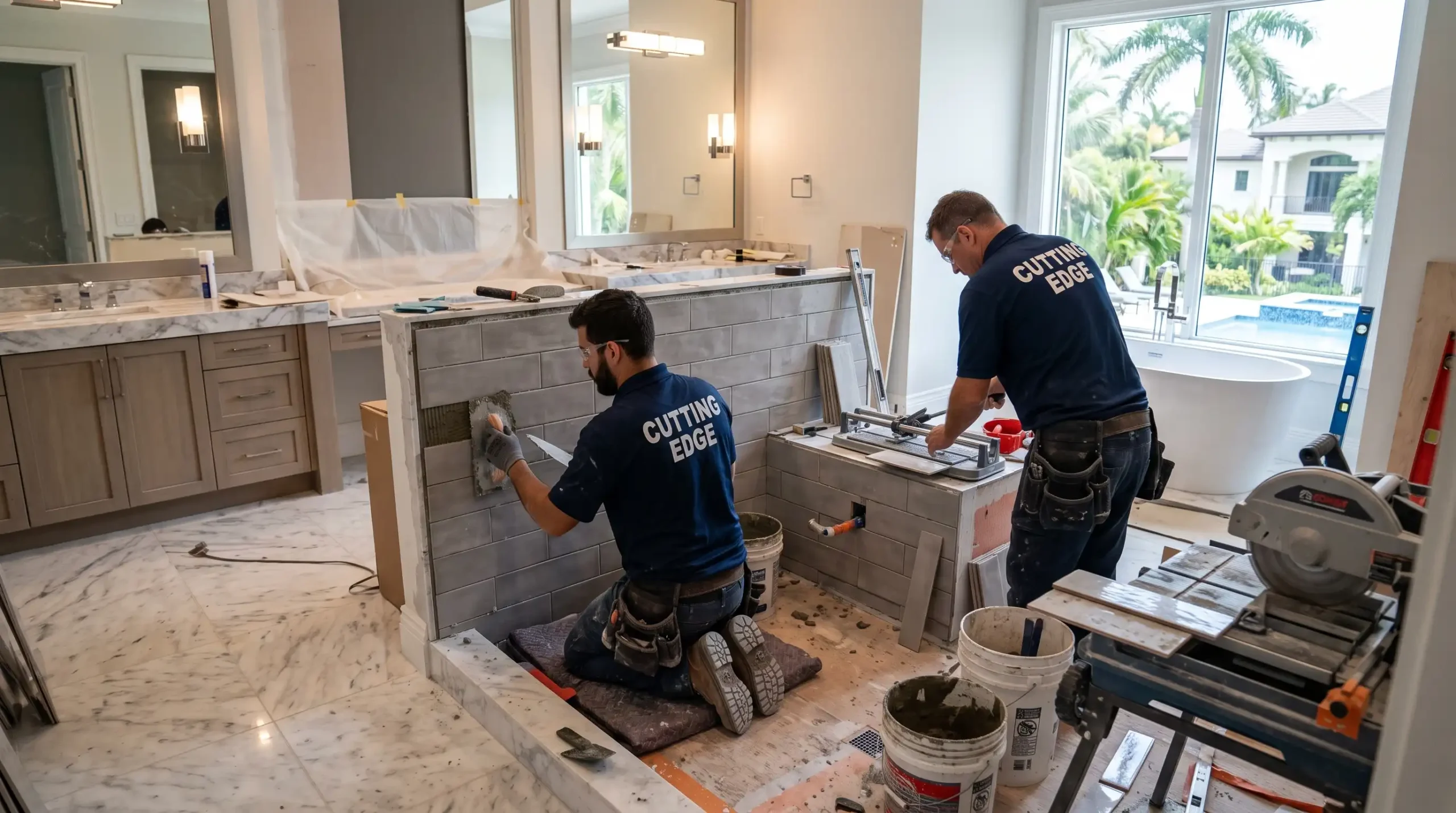
A framed enclosure runs metal around every edge of thin glass, so the frame does the structural work. Semi-frameless keeps a metal header or side channel but drops the frame around the door itself, which is why it is a popular middle option. Fully frameless relies on the weight and stiffness of heavy glass alone. A hinged frameless door is almost always 3/8 inch at minimum; 1/2 inch feels more solid and suits tall or wide panels, though it adds weight and asks more of the hinges and wall.
Configuration matters as much as thickness. A single hinged door works in an alcove. A door with a fixed inline panel suits a wider opening, and a neo-angle enclosure fits a corner. Many walk-in showers skip the door entirely and use one fixed panel. Low-iron glass removes the faint green edge of standard glass, and hardware comes in chrome, brushed nickel, matte black and brass. Price rises with glass thickness, panel count, custom angles, notches around a bench or niche, and premium hardware finishes.
| Framed | Semi-frameless | Frameless | |
|---|---|---|---|
| Typical glass | 3/16 to 1/4 inch | 1/4 to 5/16 inch | 3/8 or 1/2 inch |
| Metal on edges | All edges | Some edges, usually not the door | Only hinges, clips or a slim channel |
| Look | Traditional, more visible metal | Cleaner, some trim | Open, almost all glass |
| Cleaning | Tracks and frames trap water | Fewer places for buildup | Fewest places for buildup |
| Wall requirements | Forgiving of out-of-square walls | Somewhat forgiving | Needs blocking and accurate, square walls |
| Relative cost | Lowest | Middle | Highest |
See how frameless glass fits into our shower remodels, from walk-in panels to fully enclosed steam-ready showers.
What Changes for Glass in Southwest Florida?
Water quality is the first issue. Collier County's own water quality report puts its drinking water in the moderately hard range, and minerals left on glass after each shower can build into a cloudy film over time. A factory-applied hydrophobic coating makes water bead and run off, and a quick squeegee after use does the rest. Coastal homes near Bonita Beach and Fort Myers Beach also deserve solid brass or stainless hardware, since cheaper plated parts pit in salt air.
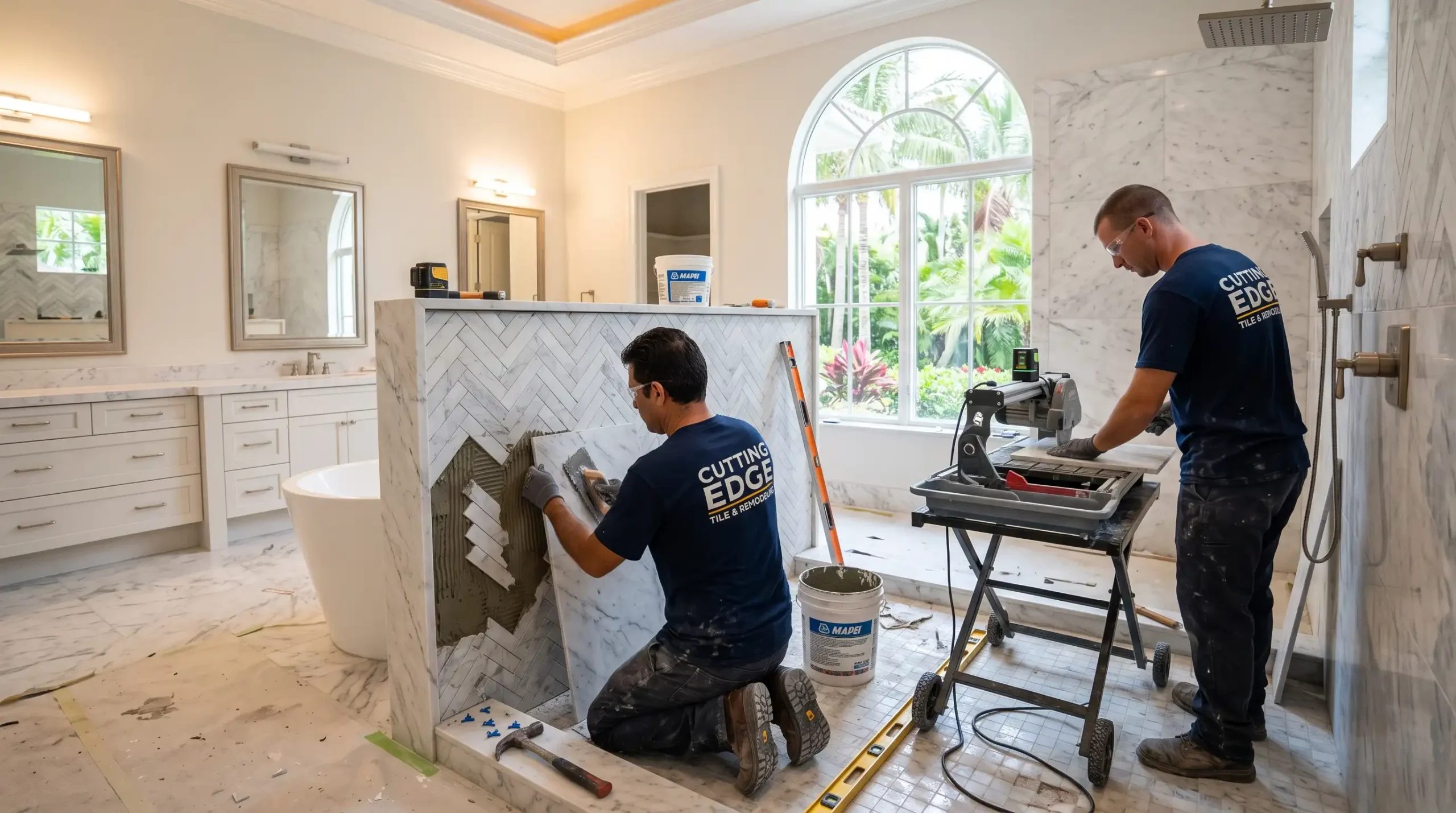
The second issue is what sits behind the tile. Heavy frameless glass hangs on the wall framing, so we plan blocking before the walls close and set the curb and jambs plumb so the glass fits without large gaps. Tempered safety glass is required by code for shower enclosures, and every panel is measured after tile is finished, then fabricated to those exact dimensions. In condos, glass deliveries are planned around elevator reservations, since a large panel may not fit in a standard car. Seasonal owners leaving for months should prop the door open so the enclosure dries out.
What Does the Safety Glass Rule Require?
Glass at a shower is a hazardous location in the residential code. As Fine Homebuilding explains, glazing is hazardous when it sits less than 60 inches above the standing surface and within 60 inches horizontally of the shower or tub, and the height is measured to the lowest visible edge of the glass, not the part hidden in a channel. Safety glazing must meet CPSC 16 CFR 1201 Category II or ANSI Z97.1 Class A, tests that drop a 100-pound weight on a 5-foot pendulum lifted 48 inches.
The same article points out that the code never names tempered glass. Tempering is simply the industry norm, and it is a strong one: tempered glass is four to five times stronger than ordinary annealed glass and, when it does break, it crumbles into small, blunt pieces. A tempered panel normally carries an etched manufacturer mark in one corner. Look for it on every panel, including fixed side panels and transoms, because the mark is what shows the inspector the glass is certified.
Why Does Tempered Glass Sometimes Break on Its Own?
It is rare, and it is worth understanding. Vitro Architectural Glass describes nickel sulfide stones, tiny inclusions 0.003 to 0.015 inch across that form during glass manufacturing, as one cause: if a stone sits in the tension zone at the center of a tempered pane, temperature swings after installation can make it grow and the pane can fail. The same source says no known technology prevents the stones entirely, and that heat soaking panels after fabrication can destroy some flawed ones but does not guarantee every stone is found. It also says a more common explanation is edge or surface damage, movement or poor engineering.
That matches what a South Florida shower door company reports: many shattering incidents trace back to installation. Over-tightened hardware, glass forced into an out-of-square opening, poor shimming and metal touching glass without a gasket all build up stress with every swing of the door. Chips on an edge deserve attention too, since a chipped edge weakens the glass. For you, the practical points are simple. Insist on gaskets at every hinge and clamp, have the opening measured after tile is set so nothing is forced, and never hang towels or hooks from a glass panel unless the manufacturer allows it.
How Much Weight Do the Hinges Carry?
Glass thickness and hinge capacity have to be matched, and the manufacturers publish the numbers. One common wall-mount hinge line is made for 3/8 or 1/2 inch tempered glass and uses a different gasket for each thickness. Its rating with two hinges is 145 pounds and a 40-inch maximum door width, and the instructions warn installers not to exceed either limit when deciding how many hinges to use. Its capacity table lists roughly 5 pounds per square foot for 3/8 inch glass and about 6.4 pounds per square foot for 1/2 inch.
By that arithmetic, a door 30 inches wide and 72 inches tall has 15 square feet of glass, or about 75 pounds in 3/8 inch and 96 pounds in 1/2 inch. Both sit under the 145-pound rating, but all of that weight hangs from two points on the wall. That is the reason we plan blocking behind the tile before the walls close, and why a wider door or a third hinge changes the plan. The hinge is also factory set to close at 90 degrees, with a field setting that adds 5 degrees of closing when a firmer position against the jamb or seal is needed.
How Are Door Swing and Opening Width Set?
The residential plumbing section on showers calls for a finished opening at least 22 inches wide, clear and unobstructed, according to Building Code Trainer's quote of the 2018 International Residential Code, and the same article quotes the rule that hinged shower doors open outward. The reasoning is practical: a person who falls inside should not be trapped by a door that swings into them, and a helper can open it from outside. Florida's residential code is built on the IRC, so we confirm the edition and any local rules during permitting before a panel is ordered.
Swing also affects splash and layout. A door that opens toward the vanity needs the floor space in front of it, and, as noted above, shower head placement and swing direction both affect splashing. A fixed inline panel beside a short door, or a single fixed panel on a walk-in, can solve both problems. Condo owners add one more step: building rules often limit delivery hours and elevator use, and a tall 1/2 inch panel is heavy and awkward, so we schedule the glass drop with the association before fabrication starts.
How Do You Care for Glass and Hardware in Hard Water and Salt Air?
Collier County's 2024 water quality report lists its drinking water hardness at 42 to 94 mg/L, or 2.4 to 5.5 grains per gallon, with an average of 67 mg/L in the moderately hard category. Water in Lee County, which includes Bonita Springs and Estero, comes from other utilities and will differ, so check your own utility's latest report. Either way, droplets that dry on glass leave minerals behind, and the coating and the squeegee both exist to keep that film from building.
Cleaning matters as much as the coating. Guardian Glass, which makes ShowerGuard, advises against abrasive powders, razor blades and abrasive brushes, and warns that hydrofluoric and phosphoric acids are corrosive to the coating and the glass. Its tested cleaners include a non-scratch sponge, glass cleaners and a 50/50 water and vinegar mixture. Always check the instructions for the specific coating on your glass, because manufacturers differ.
Hardware deserves the same attention. A stainless grade comparison from Abrams Industries notes that type 316 contains 2 to 2.5 percent molybdenum, against up to 0.11 percent in type 304, and that the molybdenum helps it resist chloride pitting; the article recommends 316 within about 5 miles of the ocean. Ask your installer which grade or which solid brass hinges are in the quote, particularly near the Gulf or tidal canals.
What Should You Compare in Two Quotes?
A frameless door quote is easy to misread because the glass is custom. Before comparing totals, line up the pieces that move the price on this page: glass thickness, the number of panels, custom angles or notches around a bench or niche, and hardware finish. Then add the questions that protect the glass over the long run.
- Is the glass tempered and etched with a certification mark, and is every panel covered, including fixed panels?
- Which hinge model and quantity, rated for what weight, and what is behind the tile where they mount?
- Is the glass measured after tile is finished, and is a protective coating included or optional?
- Which stainless grade or brass is the hardware, and does it come with gaskets at every glass contact?
- Who removes the old enclosure, and who is responsible if the opening is out of square?
When the glass is part of a full shower remodel under one contract, those answers are settled before the walls are closed, which is why we scope it that way.
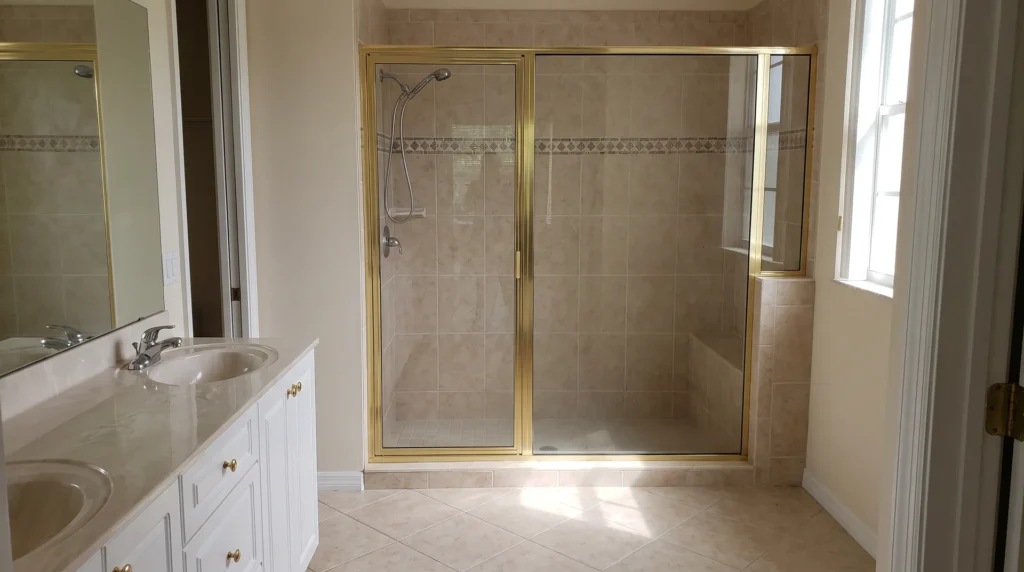
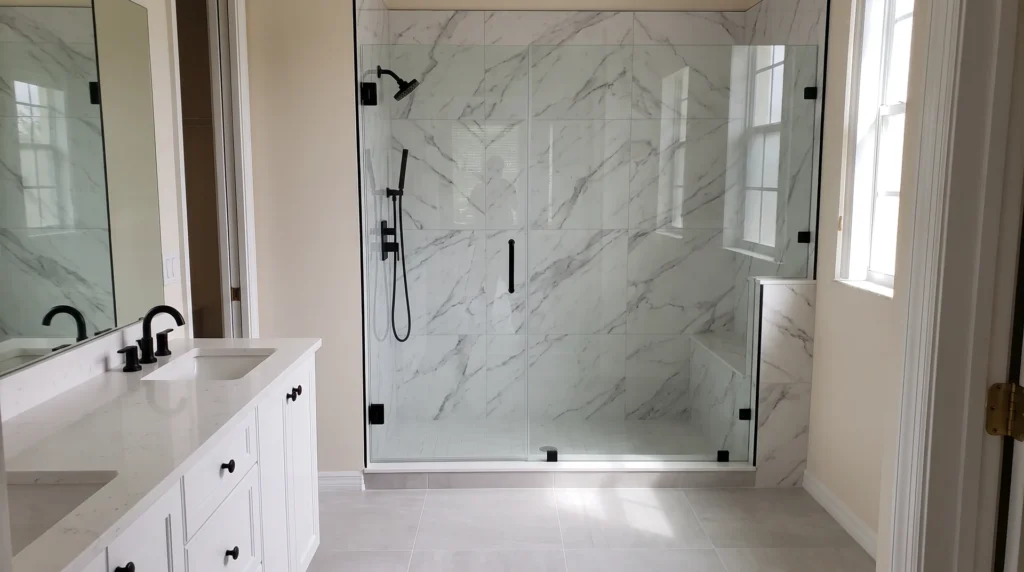
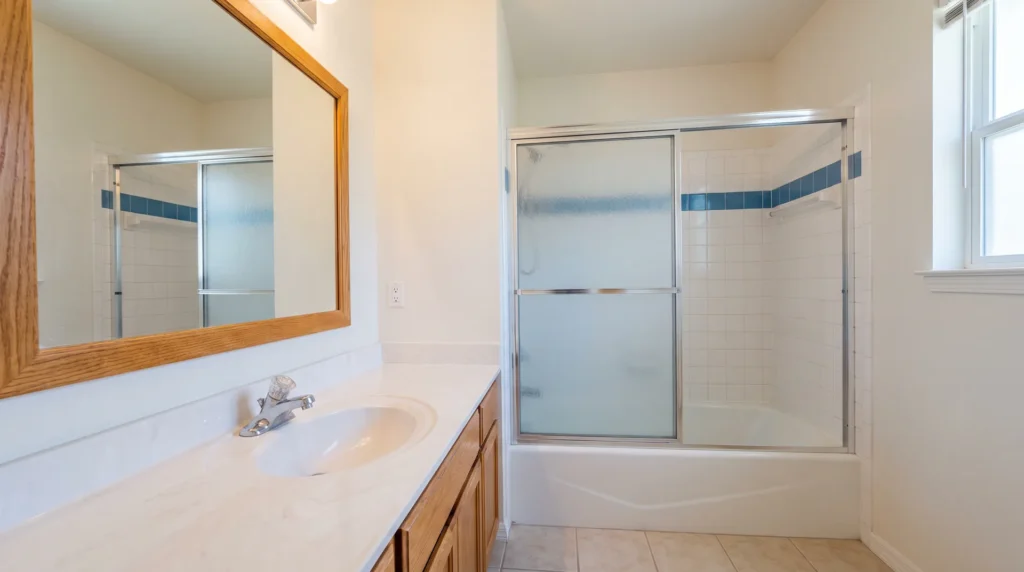
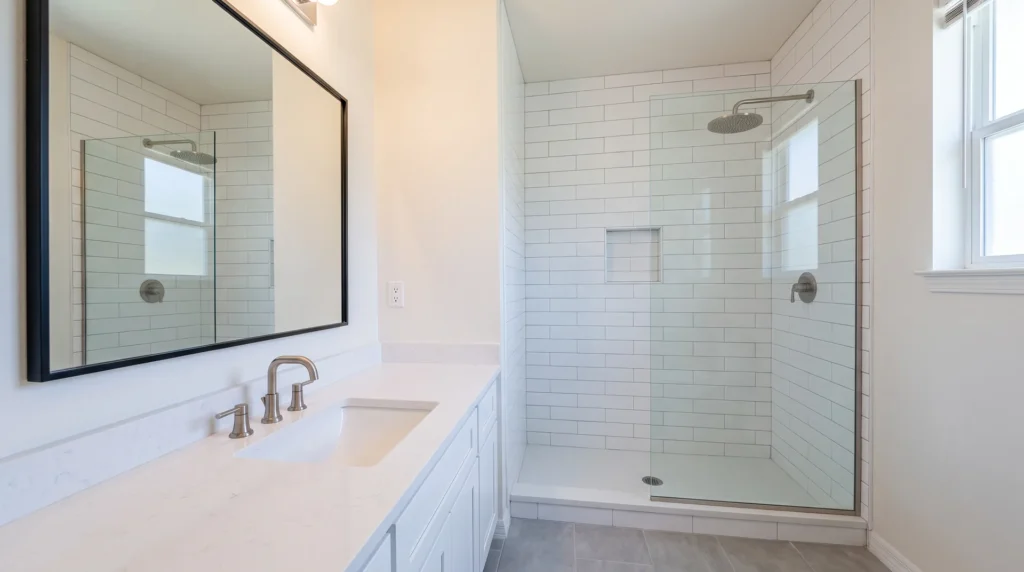
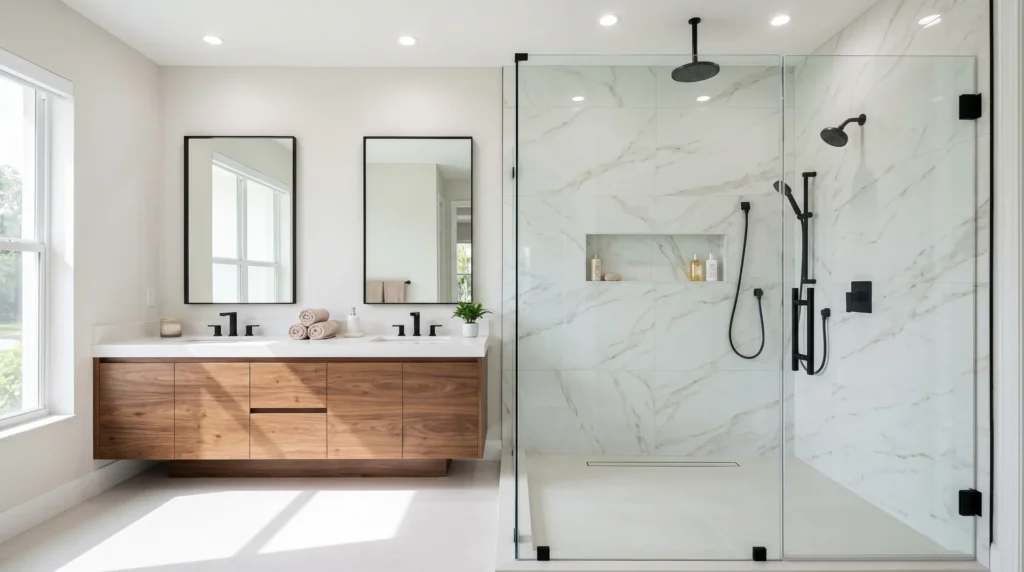
Frameless Glass Shower Before &
Frameless Shower Door Questions
Is 3/8 or 1/2 inch glass better for a shower door?
Both work well when the hardware is sized correctly. 3/8 inch is the common choice for standard hinged doors and fixed panels. 1/2 inch feels heavier and more substantial and is often chosen for tall doors, wide panels or a premium feel, but it needs stronger hinges and good blocking in the wall.
Do frameless shower doors leak?
A frameless door is not watertight like a framed one, because there are small gaps at the hinges and edges. Clear seals and a sweep at the bottom control splashing, and a properly sloped floor keeps water moving to the drain. Shower head placement and door swing direction matter too.
Can I add a frameless door to my existing shower?
Usually, if the walls are reasonably plumb and there is solid framing or blocking where the hinges land. Out-of-square walls or a sloped curb can make the fit harder. When the tile and pan are aging, replacing the glass as part of a full shower remodel avoids paying for new glass twice.
Does a frameless shower door have to be tempered?
The residential code requires safety glazing at showers, meeting CPSC 16 CFR 1201 Category II or ANSI Z97.1 Class A, and does not name tempered glass specifically. Tempered glass is the industry norm and usually carries an etched mark in a corner. Ask for that mark on every panel.
How much does a frameless shower door weigh?
It depends on size and thickness. Using one hinge maker's figures of about 5 pounds per square foot for 3/8 inch glass and about 6.4 for 1/2 inch, a 30 by 72 inch door is roughly 75 to 96 pounds, which is why the wall needs blocking behind the tile.
We scan your shower, render the glass options and include the enclosure in one fixed-price contract.
Why Bonita Springs Owners Pick Cutting Edge
Glass is the last thing installed and the first thing guests notice, so it only looks right when the shower behind it was built square, blocked and waterproofed correctly. Cutting Edge Kitchen & Bath is a licensed Florida general contractor based in Bonita Springs, with a 4,000-square-foot showroom at 28280 Old 41 Road, nine Best of Houzz awards and more than 500 Southwest Florida remodels. We start with a free LiDAR scan and photo-real 3D render, so you see the glass before it is ordered, and our own crews build the shower under one fixed-price contract.