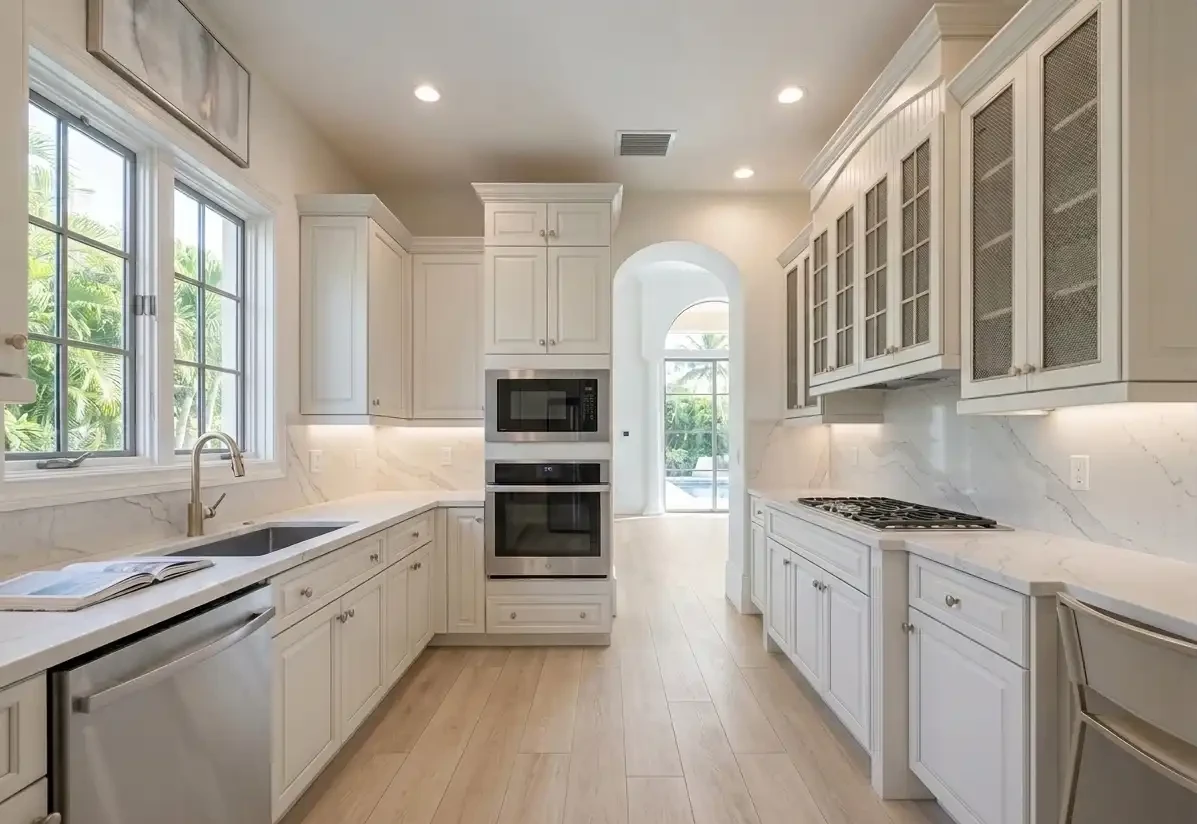
Crown Molding Installation
Scaled to Tall Florida Ceilings
Crown molding installation means fitting angled trim where the wall meets the ceiling, with coped inside corners, mitered outside corners and scarf joints on long runs. The right profile depends on ceiling height: a 3 to 4 inch crown suits 8-foot ceilings, while 10 to 12 foot ceilings need 6 to 10 inches or a built-up profile. Cost depends on linear footage, material, profile size, the number of corners and whether ceilings are tray or vaulted, so an on-site measure gives the real number.
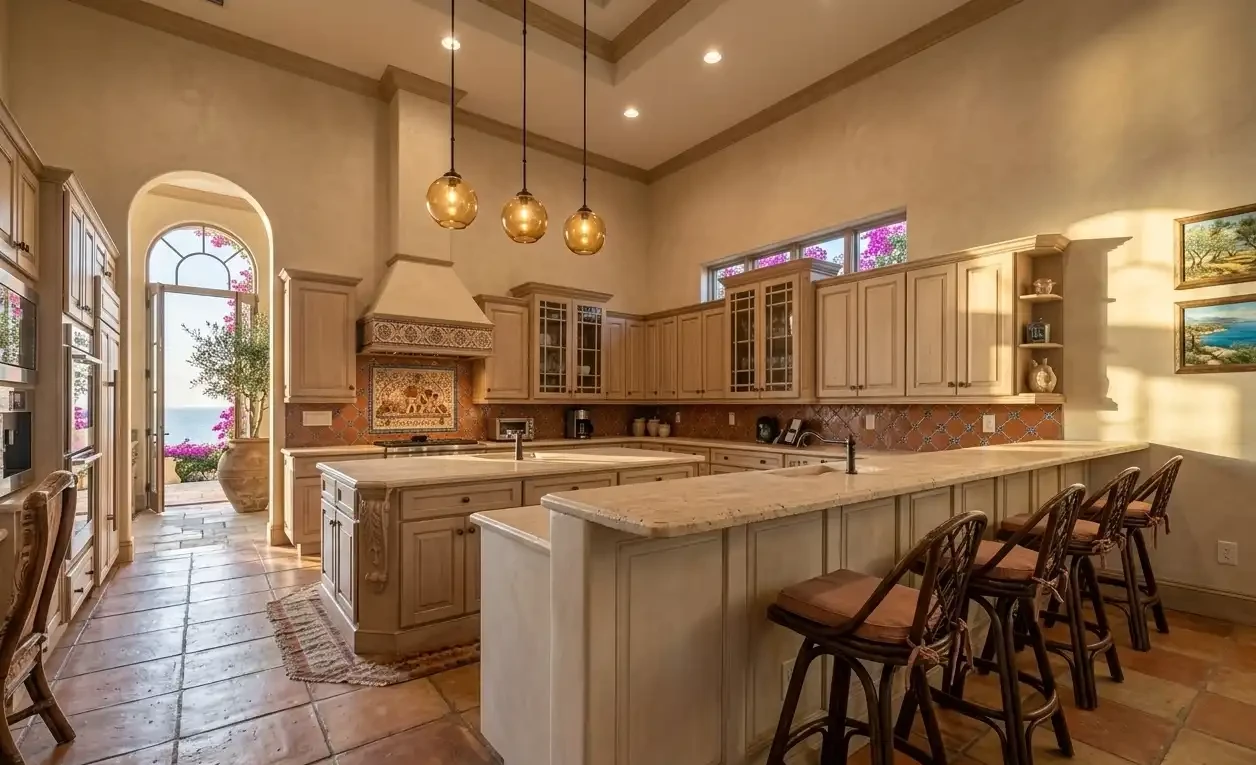
Which Crown Molding Profile and Material Should You Choose?
Scale matters more than style. A thin crown on a tall ceiling looks like an afterthought, and an oversized one in a small room feels heavy. A common rule of thumb is roughly an inch of crown height for each foot of ceiling height, adjusted for room size. On high ceilings, carpenters often build up a profile from two or three pieces, such as a crown over a frieze board and a small bed molding, which gives a large, layered look without one massive piece of trim.
Material choice depends on paint, budget and location. Primed MDF is smooth, stable and economical for painted rooms, but it swells if it gets wet. Finger-jointed pine and poplar take paint well and hold nails better. Polyurethane foam crown is light and moisture resistant, which makes it practical for bathrooms and very large profiles. Stained wood crown requires solid hardwood that matches the cabinetry. Installation time rises with every corner, every change in ceiling plane and every tray ceiling, which is why two rooms of the same size can quote very differently.
| Ceiling height | Typical crown size | Common approach |
|---|---|---|
| 8 ft | 3–4½ in | Single-piece crown |
| 9 ft | 4½–5½ in | Single piece, or crown with a small bed molding |
| 10 ft | 5½–7 in | Larger single piece or two-piece build-up |
| 11–12 ft | 7–10 in | Built-up crown with frieze board |
| Tray ceiling | Varies by step | Crown on each tier, sometimes with LED cove |
See our custom carpentry services, from crown molding and wainscoting to full built-ins and millwork.
What Is Different About Southwest Florida Homes?
Many homes here have block exterior walls finished with furring strips and drywall, plus roof trusses above the ceiling. Trusses can lift slightly with seasonal temperature and moisture changes, which sometimes opens a crack along the top of crown molding. Experienced carpenters fasten and caulk the crown so it moves with one surface instead of tearing between two. On block walls, the fastening pattern has to hit furring or framing, not bare concrete, or the trim will loosen over time.
Humidity favors stable materials. MDF is fine in conditioned rooms but should stay out of bathrooms and lanais, where polyurethane or PVC trim holds up better. Ceilings of 10 to 12 feet are common in newer Bonita Springs and Naples homes, so built-up profiles are worth considering. For seasonal owners, crown is a good project to schedule while the house is empty, since it involves ladders, cutting stations and paint in every room. Crown alone rarely needs a permit, but it often joins larger remodels that do, such as kitchens and primary suites.

Which Crown Molding Material Holds Up in Florida Humidity?
Humidity is the main material question in Southwest Florida, and the published guidance is consistent on the basic ranking. Architectural Depot says MDF is highly susceptible to moisture, while its smooth surface gives a flawless paint finish. It says wood is easily stained or painted but needs regular maintenance against pests and moisture, and that wood is significantly less flexible than other materials, which can make installation more difficult. Urethane, its term for polyurethane, is resistant to moisture, insects and temperature changes, is lightweight and easier to handle than wood, and often arrives unfinished, so it needs paint. PVC is called an excellent choice for bathrooms, kitchens and other moisture-prone areas because it is completely waterproof.
Movement is a separate issue from water damage. Home Addition Plus notes that solid wood shrinks and swells with temperature and humidity changes, which can leave joints separated, cracked or split. It describes MDF as less susceptible to shrinking and expansion, PVC as impervious to moisture, rot and insect damage and unlikely to shrink or warp, and polyurethane as more stable than wood and easier to install. Those statements do not contradict the point above about MDF: the material may hold its dimensions in a dry, conditioned room while still swelling if liquid water reaches it. Bob Vila's guide adds that polyurethane and PVC suit humid areas where wood tends to warp, that MDF is softer and prone to nicks, and that plaster requires professional installation.
For a homeowner, that points to a simple room-by-room approach. Conditioned living areas with painted trim are where MDF or wood make sense. Baths, laundry rooms and covered lanais, where moisture or humidity swings are more likely, are where PVC or polyurethane earn their keep. Stained wood remains an option when it needs to match cabinetry, though it asks more of both the installer and the climate control. Ask any installer which material they plan to use in each room and why, and ask what finish they apply to cut ends, since the guidance above is about the material itself, not about workmanship.
How Should Crown Be Joined, Fastened and Finished?
Technique decides whether the trim still looks tight after a year of humid summers. Bob Vila's guide says wood crown attaches with finish nails or finish screws to both the ceiling plate and the wall studs, and that oversize profiles may need additional blocking in the ceiling for support. For inside corners in wood and MDF it recommends coping, writing that coped joints mimic miter joints but do not gap, and it discourages inside miters in those materials because fastening can open gaps. For PVC and polyurethane it describes 45-degree miters at both inside and outside corners, with latex caulk filling inside corners and gaps before painting.
Precision matters because trim is unforgiving. MT Copeland, a moulding supplier, says measurements and fits must be exact, that small gaps can be hidden with caulk and paint, and that imprecise cuts mean buying more trim. It says wood needs finish carpentry skills and specialty cuts, and that plaster is best left to professionals. It also states that professionals can install crown in about one to two hours per room. Treat that as a source's baseline for a simple room, not a quote: built-up profiles, tray ceilings and many corners add cuts, and your installer should explain how they account for them.
When you compare bids, look for specifics. Does the proposal name the material and profile for each room, say how inside corners will be joined, and say what is done about blocking for large crown? Is paint included, and how many coats? A proposal that only lists a linear-foot number leaves those decisions open, and the answers affect how the trim ages.
Does Crown Molding Need a Permit or Association Approval?
The permit question depends on what else you are touching. The City of Naples "When do I need a permit?" page lists painting and wallpaper, carpet, ceramic tile, plumbing fixture replacement and ceiling fan replacement using an existing box among work that needs no permit. It does not list trim either way. The same page says any installation, alteration or replacement of an electrical, gas, mechanical or plumbing system does need one, so an LED cove light with new wiring behind the crown is a different matter from the crown itself. Confirm with the office for your address: City of Naples Building at 295 Riverside Circle, 239-213-5020, Collier County Building Plan Review and Inspection at 2800 N. Horseshoe Drive, 239-252-2400, or Bonita Springs Community Development at 9220 Bonita Beach Road SE, Suite 111, (239) 444-6150. Call ahead to confirm before you visit.
In a condominium, the ceiling is also an insurance question. Florida Statute 718.111(11)(f) excludes floor, wall and ceiling coverings and electrical fixtures that serve only a unit from the association's property coverage. New trim, paint and cove lighting therefore sit on the owner's side of the line, so ask your own insurer how they are covered and keep photographs and invoices. Before work starts, ask the association what notice, work hours and insurance certificates it requires, since those rules are set by each building, not by the state.
How Do You Check a Crown Molding Installer in Florida?
Trim carpentry can look like small work, but the hiring checklist is the same as for a full remodel. A Florida Department of Business and Professional Regulation consumer tips sheet says to verify the license number with DBPR and check for any complaints. It defines unlicensed activity as offering or performing services that require a state license without holding one. Among the warning signs it lists is a contractor who tries to convince you a permit is not necessary or that it is cheaper if you obtain it yourself.
The same sheet advises getting written estimates from licensed contractors and making sure each one states the work to be done, the materials involved, the completion date and the total cost. It also says a licensed contractor should carry proper workers' compensation or liability insurance. For crown molding, put the material, profile height, rooms, paint and cleanup in that written description, and ask for proof of insurance before anyone sets up a ladder in your home.
Crown Molding Questions
How is crown molding installation priced?
Most carpenters price crown by the linear foot, with adjustments for material, profile size, built-up layers, corners, ceiling height and painting. Tray and vaulted ceilings take longer. Because those factors vary so much, we measure the rooms and quote a fixed price rather than guess from square footage.
What size crown molding should I use for 10-foot ceilings?
For 10-foot ceilings, a crown in the 5½ to 7 inch range usually looks proportional, or a two-piece build-up of similar total height. Larger rooms can handle more. We often render two sizes in 3D so you can compare them before anything is cut.
Is MDF crown molding OK in Florida?
Primed MDF works well in air-conditioned living spaces, where it stays stable and paints smoothly. It should not be used in bathrooms, laundry rooms or anywhere it could get wet, because it swells. Polyurethane or PVC crown is the safer choice in those areas.
Which crown molding is best for a Florida bathroom or lanai?
Architectural Depot calls PVC an excellent choice for moisture-prone areas because it is completely waterproof, and says polyurethane resists moisture, insects and temperature changes. Bob Vila's guide says polyurethane and PVC suit humid areas where wood tends to warp. Wood and MDF are better kept to drier, conditioned rooms.
Should inside corners of crown molding be coped or mitered?
For wood and MDF, Bob Vila's guide recommends coped inside corners because they avoid the gaps that fastening can open in inside miters. For PVC and polyurethane it describes 45-degree miters at inside and outside corners, with latex caulk in the joints before paint.
Do I need a permit to install crown molding in Naples?
The City of Naples lists painting, ceramic tile and plumbing fixture replacement as work not needing a permit but does not list trim. Electrical alterations, such as new wiring for cove lighting, do need one. Check with the building office that covers your address.
How do I verify a crown molding installer is licensed in Florida?
A DBPR consumer tips sheet says to verify the license number with the Department of Business and Professional Regulation and check for complaints. It also advises written estimates that state the work, materials, completion date and total cost, plus proof of workers' compensation or liability insurance.
We scan each room, render the crown profiles side by side and quote the installation at one fixed price.
Finish Carpentry Clients Pick Cutting Edge
Good crown molding depends on carpenters who scale profiles to the room and cope corners tight, and on knowing how Florida trusses and block walls behave. Cutting Edge Kitchen & Bath employs its own finish crews and has completed more than 500 Southwest Florida remodels, earning nine Best of Houzz awards along the way. Our Bonita Springs showroom at 28280 Old 41 Road displays trim and millwork alongside cabinetry. We begin every job with a free LiDAR scan and photo-real 3D render, so you see the profile in your room before signing one fixed-price contract.
Key Takeaways
- Crown size scales with ceiling height, from 3 to 4½ inches at 8 feet to 7 to 10 inches at 11 to 12 feet.
- Architectural Depot calls PVC an excellent choice for bathrooms, kitchens and other moisture-prone areas because it is completely waterproof.
- Primed MDF swells when wet, so the post keeps it out of bathrooms and lanais and uses it in conditioned rooms.
- Bob Vila's guide recommends coped inside corners for wood and MDF because coped joints do not gap the way inside miters can.
- Crown alone rarely needs a permit, but electrical work such as LED cove lighting with new wiring does, according to the City of Naples permit guidance.