Cabinet Refacing in Bonita Springs
& Fort Myers Beach
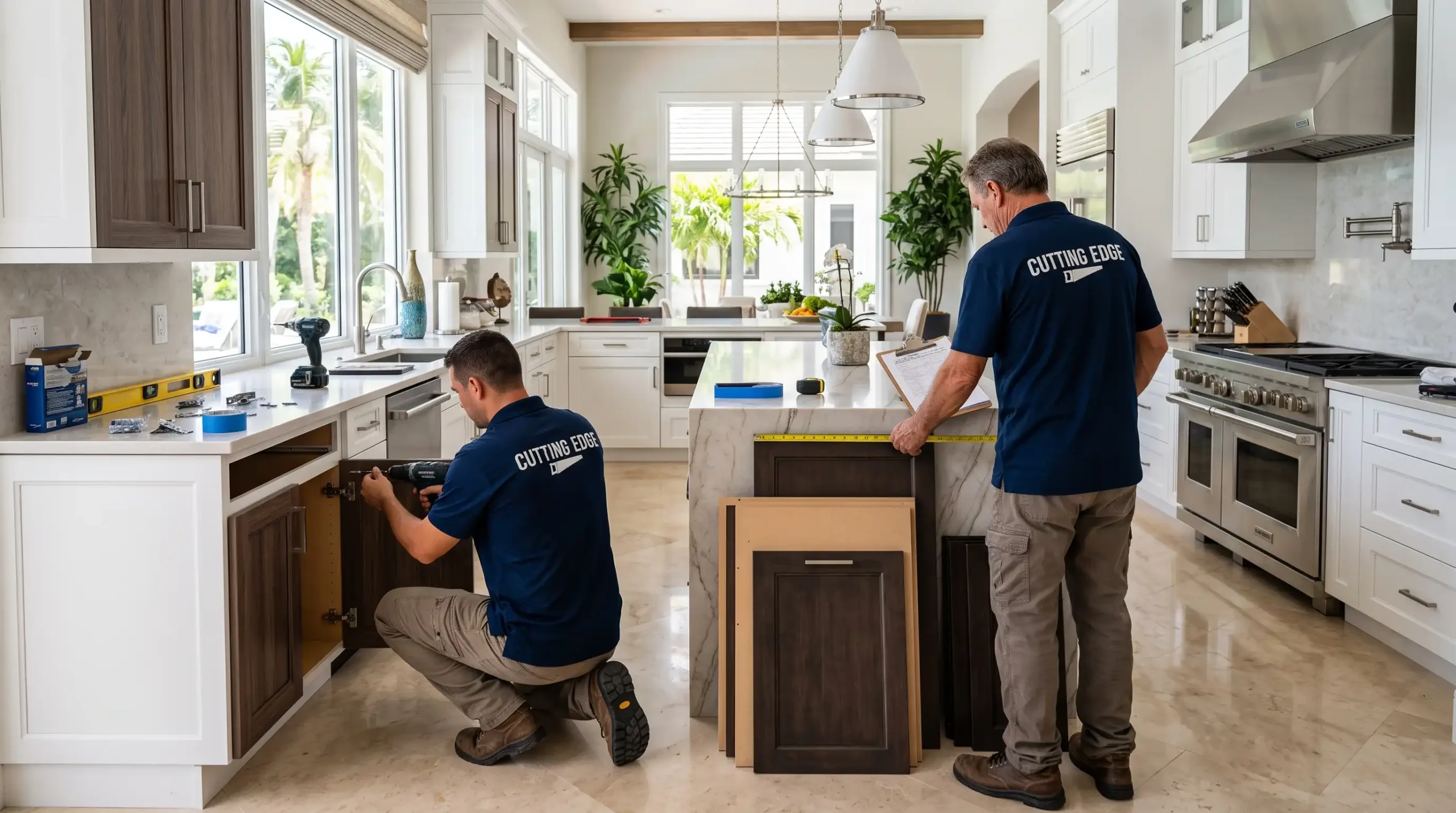
Half the kitchens in Southwest Florida have perfectly sound cabinet boxes wearing twenty-year-old doors. If the boxes are plumb, dry, and solidly anchored, refacing delivers a genuinely new-looking kitchen — new doors and drawer fronts in the style you choose, matched veneer on every exposed surface, new hinges, slides, and hardware — for roughly half the cost and a fraction of the disruption of replacement. No demolition, no weeks without a kitchen.
The catch is that refacing is only as good as the assessment and the craft. Boxes with water damage, particle-board sag, or failed joinery should not be refaced — and we will tell you so, because we build new cabinets too and have no reason to push either answer. When refacing is right, our own carpenters do the fitting, and the difference between a wrapped look and a built look is exactly there.

Reface, Paint,
Or Replace — Honestly.
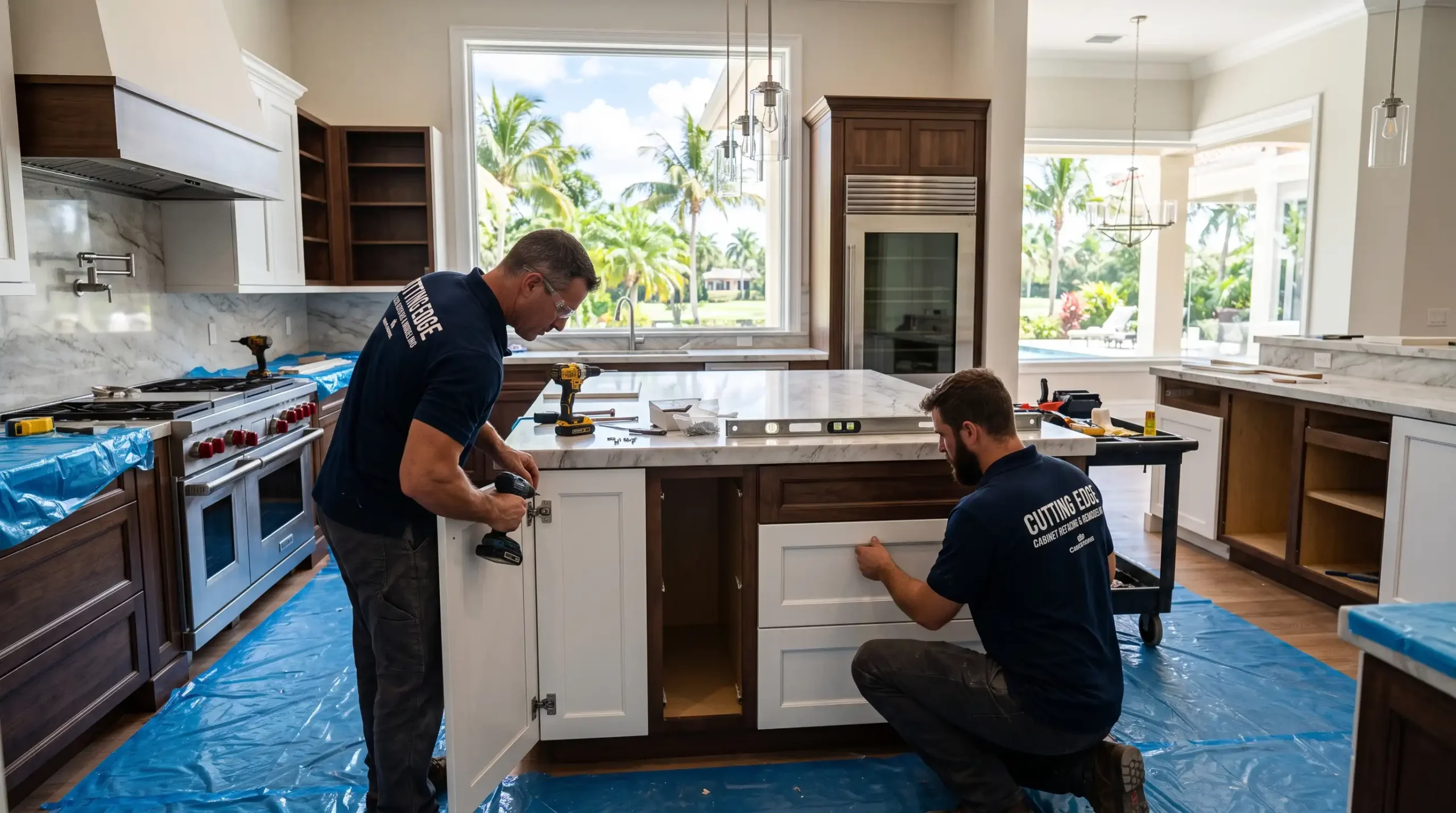
There are three ways to renew a kitchen’s face, and we offer all three: professional cabinet painting when the doors are good and the budget is tight, refacing when the boxes are sound but the style is dated, and full replacement when layout or box condition demands it. Because we sell all three, the recommendation you get is based on your cabinets — not on what the company happens to sell. The assessment is free, and every path ends with the same thing: a photo-real render of the finished kitchen and one fixed price.
Everything You See,
Renewed.
What Refacing Actually Involves, Start to Finish.
If you are comparing cabinet refacing in Bonita Springs, Naples or Fort Myers, the useful questions are narrow: are my boxes worth keeping, what will the new fronts be made of, what is and is not included, and how long will the kitchen be disrupted. This guide answers those in the order a real project runs, so you can compare a refacing quote against painting or replacement on equal terms.
What refacing is, and what it is not
Refacing keeps your existing cabinet boxes and the kitchen layout. The visible parts change: the doors and drawer fronts are replaced, and new veneer is applied to the exposed faces of the boxes so everything matches. Hardware is renewed at the same time. Because the boxes stay, the layout stays. If the real problem is a work triangle that fights you, an island that will not fit, or too little storage, refacing cannot fix it, and a layout change means new cabinets.
The method depends on the style of cabinet. According to Hunker, on flat-panel cabinets the new veneer is glued over the sides, doors and drawer faces, while on frame-and-panel cabinets the face frames and sides are veneered and the doors and drawer fronts are replaced. Veneer can be plastic laminate or real wood, and rigid thermofoil is also used for doors and drawer fronts.
Step 1: the box assessment
Everything depends on the condition of what stays. A reasonable checklist, drawn from the Home Depot refacing guide, is that the cabinets are plywood or MDF with smooth surfaces in good condition, the drawer tracks and shelves still work, and the face frames are solid wood. If those checks fail, replacement doors or new cabinets are the better spend. Hunker adds the cases refacing cannot fix: structurally unsound or poorly designed cabinets, cheap particleboard that is wet, swollen or deteriorating (the adhesive may not bond to it), and broken or warped frames that cannot be repaired.
This is why the free assessment comes first on our process. We also build new cabinets and offer professional cabinet painting, so we have no reason to steer you toward the wrong one of the three.
Step 2: choosing door style, material and finish
You pick the door style by hand in the showroom, and the render shows it in your kitchen before anything is ordered. The decisions that matter most:
- Door style. Shaker, slab or raised panel. Door style changes the look of the room more than any other single choice, so see samples in person.
- Wood veneer. Natural to dark tones that can be stained, glazed or painted. Hunker describes wood or laminate as the two veneer choices; the Home Depot guide uses wood veneer, stained and sealed with polyurethane, and arranges doors so the grain runs the same direction.
- Laminate or thermofoil. A low-maintenance surface. Be aware of the limits: CabinetIQ explains that thermofoil is a vinyl film heat-bonded over an MDF core, and its weak points are heat and steam. Doors beside ovens, ranges, microwaves and dishwashers are the most exposed, and a peeled or bubbled door usually cannot be touched up, only replaced. Filler strips, heat shields and consistent use of the exhaust hood reduce the risk. If your kitchen has a range with doors close beside it, ask for a material other than thermofoil on those doors.
- Hardware. New hinges, drawer slides, pulls and knobs. Soft-close hardware is what makes refaced cabinets feel new rather than just look new.
Step 3: the work itself
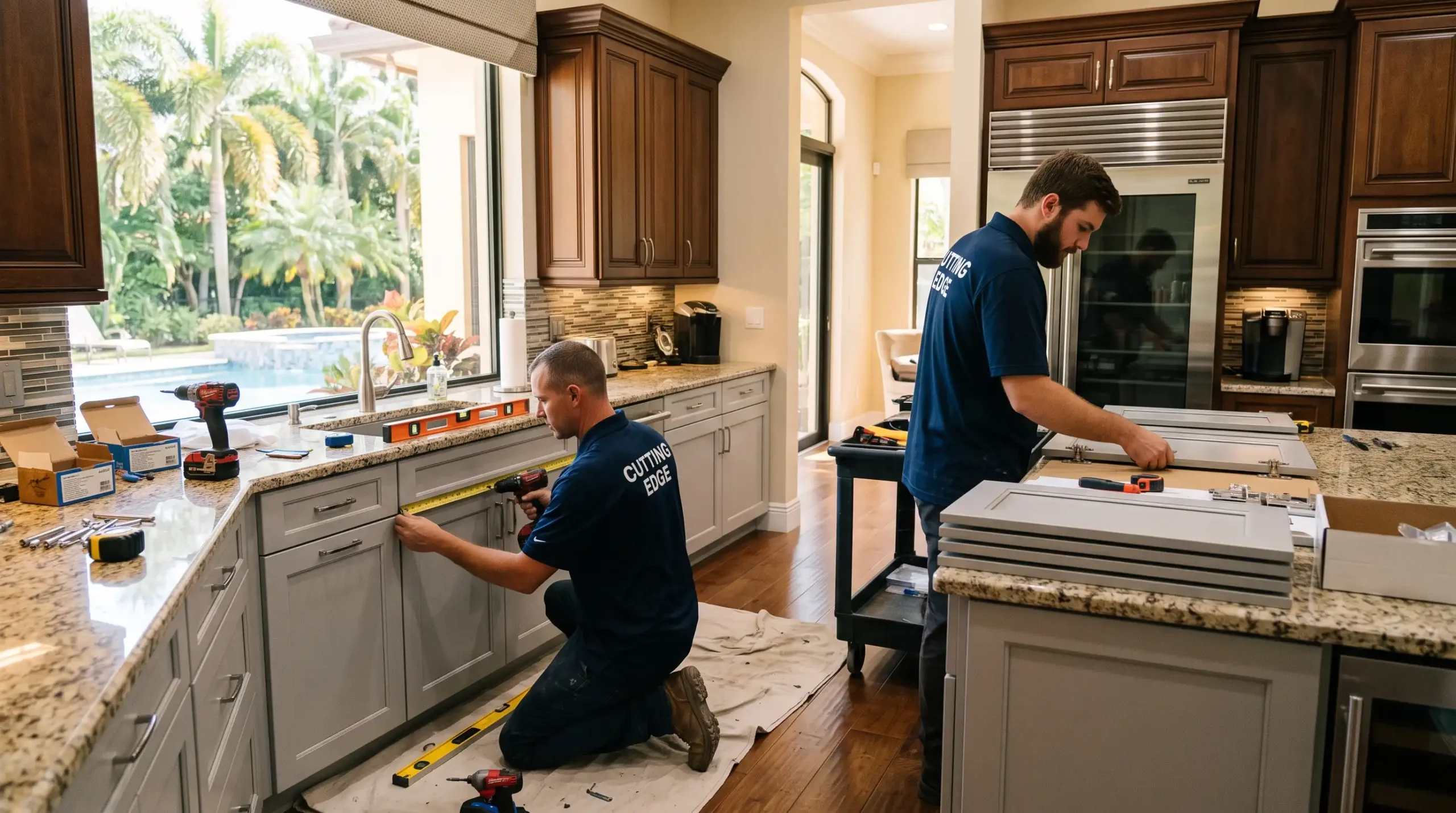
The order of work on a typical refacing job is consistent. Doors, drawers and hardware come off, and surfaces are cleaned and sanded. Any lifted or cracked old veneer is removed. Exposed ends get new panels where needed, and veneer is applied to the face frames, stiles first and then rails. New doors and drawer fronts are fitted, hinges are bored and set, and the hardware goes on. This is where a carpenter matters: hinges should be re-bored, not forced into old stripped holes, and doors should sit with an even reveal. Refacing earns its bad reputation from rushed wrap jobs, and the fix is craft in the fitting, which is why our own carpenters do it.
How long it takes
Our refacing projects run about a week, and the kitchen stays usable throughout because there is no demolition. For context, Hunker puts professional refacing at about 3 to 5 days on a typical job. The render approval and door order happen before the on-site week begins.
What drives the cost
Refacing is priced from the same few inputs on every job, and each shows up as a line in the quote:
- Linear footage of cabinets, and the number of doors and drawer fronts
- Door style and material: a flat slab costs differently from a profiled raised panel or a stained wood door
- Whether the box repairs are needed before veneer goes on
- Hardware choices, soft-close upgrades and add-ons such as roll-outs, trash pulls, crown and under-cabinet lighting
- Whether counters and backsplash are replaced in the same visit
As stated above, refacing typically costs 40–60% of full replacement for the same door style, and the quote is fixed after the assessment. Hunker likewise describes refacing as costing about half of professional replacement.
Refacing, painting or replacing: how to decide
- Paint when the doors and boxes are good and only the color is wrong. It is the lowest-cost route.
- Reface when the boxes are sound and the layout works, but the door style, finish or hardware is dated.
- Replace when boxes are swollen, sagging or failing, or when the layout needs to change. If you are doing counters at the same time, see countertop installation; for new boxes, see cabinet installation.
Hunker notes that solidly built older solid-wood cabinets can last another 20 years or more after refacing, while cheap or water-damaged boxes should not be refaced at all. An honest assessment is worth more than a quote.
Condo and single-family kitchens
The difference is mostly logistics. Refacing makes less noise, dust and debris than demolition, which helps in a condo where an association may restrict work hours and require you to move materials through shared elevators and hallways. Check your building’s rules for contractor access and work hours before scheduling. In a single-family home the main consideration is the cabinets themselves: older homes in Southwest Florida often have boxes that are worth keeping, and a kitchen that is otherwise fine is the ideal refacing candidate.
What to ask any refacing contractor
- Will you inspect the boxes first, and will you tell me if they should not be refaced?
- Which door material is proposed beside the range and dishwasher, and why?
- Are hinges re-bored, and are the slides and hardware replaced or reused?
- Is the price fixed, and does it include every exposed surface: ends, faces and toe kicks?
- Who does the fitting: carpenters, or a wrap crew?
Our consultation answers all five: an honest box assessment, a free LiDAR scan and photo-real render, a showroom visit to choose doors and hardware, and a fixed-price quote for refacing, painting or replacement.
Refacing
FAQs.
How much does cabinet refacing cost in Bonita Springs?
Typically 40–60% of full replacement for the same door style — the exact number depends on linear footage and door selection. You get a fixed quote after a free assessment; the number we quote is the number you pay.
How long does refacing take?
Most kitchens reface in about a week, and the kitchen stays usable throughout — no demolition, no living out of the garage.
Is refacing worth it, or should I replace?
If the boxes are sound and the layout works, refacing is one of the best value plays in remodeling. If boxes are damaged or the layout fights you daily, replacement is the honest answer — and we will tell you which applies for free.
Can any cabinet be refaced?
No. The boxes need to be sound: plywood or MDF in good condition, working drawer tracks, and solid face frames. Wet, swollen or deteriorating particleboard and broken or warped frames are reasons to replace instead.
What is the difference between refacing and painting cabinets?
Painting changes the color of the doors and boxes you already have. Refacing replaces the doors and drawer fronts and covers the exposed box faces with matching veneer, so the style, finish and hardware all change.
Is thermofoil a good choice for refaced doors?
It is low maintenance, but thermofoil is a vinyl film over an MDF core and is vulnerable to heat and steam. Doors next to the range, microwave or dishwasher are the most exposed, so we discuss other materials for those positions.
Can refacing work in a condo kitchen?
Yes, and with less demolition than replacement it is usually easier on building logistics. Check your association’s rules on contractor work hours and elevator or hallway access before scheduling.
Fitted by Carpenters,
Not Wrapped by Installers.
Refacing earns its bad reputation from rushed wrap jobs — bubbled veneer, misaligned doors, hinges reusing stripped holes. Ours is carpentry: the same craftsmen who build our custom kitchens fit every door, re-bore every hinge, and finish every edge, with materials you selected by hand in our Bonita Springs showroom and a photo-real render approved before we order a single door. One fixed price, one week, the 500-project standard.
Your Kitchen’s New Face.
One Week Away.
Your free consultation includes an honest box assessment, a free LiDAR scan and photo-real render, a showroom visit to choose doors and hardware in person, and a fixed-price quote for refacing, painting, or replacement — whichever your kitchen actually needs.
Key Takeaways
- Refacing keeps the existing cabinet boxes and kitchen layout, replacing doors, drawer fronts, and hardware while matched veneer covers the exposed box surfaces.
- Hunker lists plywood or MDF in good condition, working drawer tracks, and solid face frames as checks a box must pass before refacing.
- CabinetIQ explains that thermofoil is a vinyl film heat-bonded over an MDF core, with heat and steam as its weak points.
- Cutting Edge's refacing projects run about a week, and the kitchen stays usable because there is no demolition.
- Refacing typically costs 40 to 60% of full replacement for the same door style, and the quote is fixed after the free assessment.